
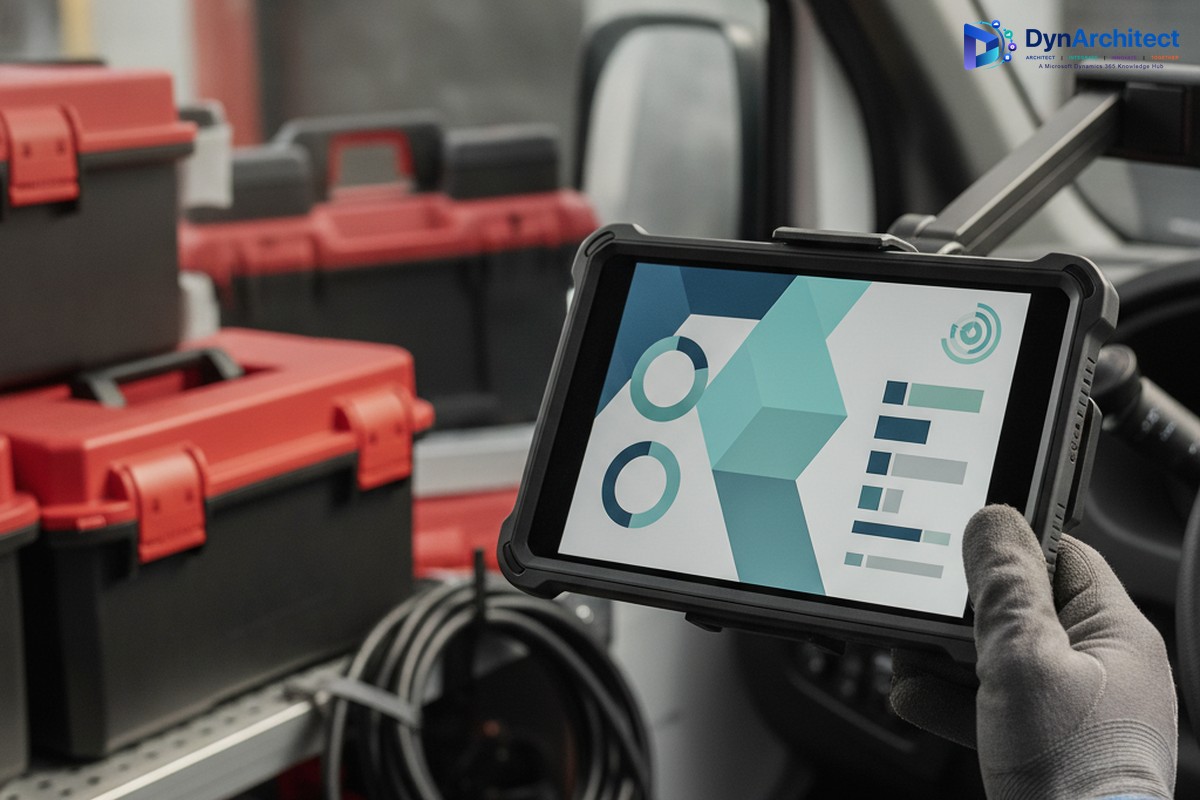
A field technician pulls into a rural service site with one bar of signal, opens the Dynamics 365 Field Service mobile app to check the work order, and gets a blank booking screen. No linked asset. No contact history. No parts list. The dispatcher, sitting in an office with full connectivity, sees the record perfectly. By the time anyone traces the problem, three more technicians have hit the same wall in three different territories, and the rollout that was supposed to cut truck-roll callbacks is instead generating help desk tickets.
Nine times out of ten, this isn’t a connectivity problem. It’s an offline profile problem, and it’s almost always self-inflicted during setup rather than caused by anything Microsoft shipped broken. The mobile offline profile is the single control surface that decides what data a technician’s device downloads before it goes dark, and getting it wrong doesn’t throw an error message. It just quietly leaves data out.
What the Mobile Offline Profile Actually Controls
Every Field Service mobile deployment starts from a default profile, “Field Service Mobile – Offline Profile,” preloaded with the tables most implementations need: bookable resource bookings, work orders, and the handful of related entities technicians touch in the field. Each table in the profile carries its own filter and its own sync frequency, and the defaults are conservative on purpose. Bookings, for instance, are filtered out of the box to only those starting within the next seven days, which keeps the initial download small but also means a technician who needs to glance at next month’s schedule offline simply can’t.
The part that trips up most implementations isn’t the top-level filters. It’s item association: how child tables inherit scope from their parent. When a table is configured with a “related rows only” filter, it doesn’t get its own independent rule, it borrows whatever the parent table’s filter already decided. If a work order filter is scoped to status equals Scheduled, and the contact table beneath it is set to related rows only, technicians lose visibility into every contact tied to a work order that isn’t currently in Scheduled status, including ones they closed out an hour ago and now need to reference for a warranty callback. This is rarely intentional. It’s usually the byproduct of an admin extending the default profile with a new custom table, applying “related rows only” because it’s the fastest configuration path, and never testing what happens once a record moves out of the parent filter’s scope.
Where FetchXML Earns Its Place
Point-and-click filters cover a lot of ground, but they run out fast once the business logic gets specific: technicians who should only see assets under an active maintenance contract, or work orders filtered by a custom priority field that doesn’t map cleanly to the standard filter builder. That’s what the FetchXML editor built into the offline profile experience is for. It sits underneath the same table configuration screen as the standard filter UI, and it lets an admin or developer write the actual query logic that determines what gets pulled down, rather than settling for whatever combinations the visual filter builder happens to expose.
Two details matter here that don’t show up until you’re debugging a slow sync in production. First, table relationships in an offline profile are capped at fifteen linked tables, counting the downstream relationships each linked table pulls in, so a profile built by repeatedly adding “just one more related table” to solve an edge case will eventually hit a wall that has nothing to do with data volume and everything to do with query complexity. Second, several standard tables never make it into offline mode at all regardless of how the FetchXML is written, among them purchase orders, agreements, and return-to-vendor or return-merchandise-authorization records. If a workflow depends on a technician checking RMA status from a job site with no signal, that has to be redesigned around the platform’s boundaries rather than configured away.
The Update Trap Almost Nobody Reads About Until It Bites
Microsoft updates the default offline profile periodically as part of ongoing Field Service releases. That sounds like a convenience, and for tables you haven’t touched, it is: their sync filters get refreshed automatically, though the updated version lands unpublished, waiting for an admin to review and accept it rather than going live silently. The trap is on the other side. The moment you edit a table’s sync filter yourself, that table is permanently excluded from future automatic updates to its filter logic. Your customization sticks, which is usually what you want, but it also means nobody upstream is going to quietly fix a filter you configured eighteen months ago if Microsoft later improves the default logic for that table. Teams that treat the offline profile as a set-and-forget configuration item, rather than something reviewed on the same cadence as the rest of their Field Service solution, tend to find this out the hard way when a filter that was reasonable at go-live has quietly become wrong as the business changed around it.
Sync Behavior and the Conflict Question Nobody Asks Until It Happens
Sync intervals per table can be set anywhere from five minutes to a full day, and a related table with a shorter interval than its parent will pull the parent’s sync cadence down to match, which is a reasonable default but one worth knowing about before you tune a slow-changing table to sync once daily and then wonder why it’s still refreshing every few minutes. The conflict scenario that actually matters operationally is what happens when a technician edits a record offline while a dispatcher edits the same record online before the technician’s device reconnects. Dynamics resolves this at the table level, not the field level, meaning it can’t merge a technician’s parts-used update with a dispatcher’s status change on the same booking if both touched the record. By default, the technician’s offline change wins when the sync finally reconciles; that behavior can be flipped so the dispatcher’s online change takes precedence instead, but it’s a system setting, not something either side of that conflict controls in the moment. Organizations that run high-volume dispatch operations with technicians frequently going in and out of coverage should decide which side should win deliberately, rather than discovering the default behavior mid-incident.
Building a Profile That Holds Up in Production
The practical guidance that actually prevents the blank-screen scenario starts with resisting the urge to filter on “all records” for any table technicians don’t strictly need in full. A technician-scoped view like “my recent bookings” instead of the full bookings table, paired with tight date-range filters, keeps the initial download fast and avoids syncing data nobody in the field will use. For custom logic that needs to run without a network connection, offline-capable JavaScript on the form is the right tool, not a Power Automate flow, since cloud flows simply don’t execute until the device reconnects, which means any process depending on one won’t fire while the technician is actually offline. When custom commands query offline data directly, keeping concurrent database calls to two or three at a time avoids performance degradation on lower-end field devices, and using FetchXML paging with a page cookie rather than pulling an entire table in one request keeps large tables from stalling initial sync. Finally, testing a profile against a realistic data volume, not a clean sandbox with a handful of sample records, is what actually surfaces the fifteen-table ceiling and the related-row inheritance trap before a rollout, rather than after one.
None of this is exotic configuration. It’s closer to data modeling than app administration, and it rewards the same discipline: understand what each table’s filter actually inherits, know where the platform’s hard limits sit before you design around them, and revisit the profile as a living part of the solution rather than a one-time setup task. Teams we’ve worked with on Field Service rollouts consistently find that the offline profile, more than any other single configuration piece, determines whether the mobile app earns trust in the field or becomes the thing technicians route around.
#FieldServiceMobile #DynamicsFieldService #FetchXML #OfflineDataSync #EnterpriseMobility