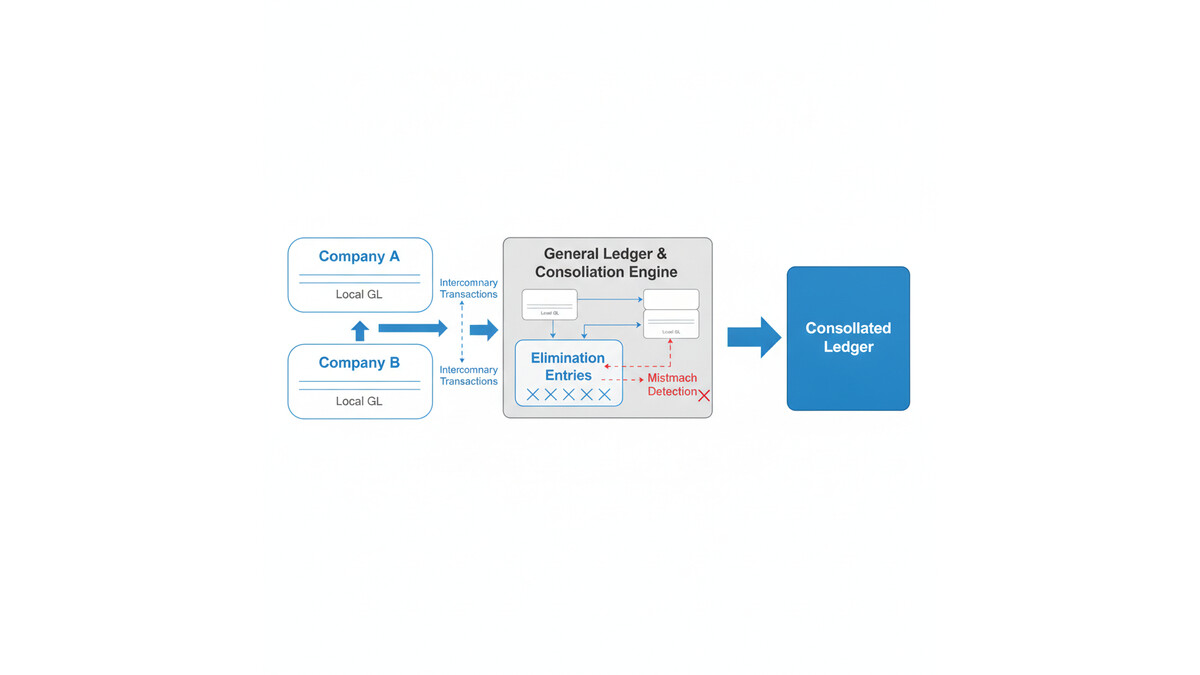
Every CFO implementing Business Central for a multi-entity organization asks the same question within weeks: “Where is the consolidation module?” The answer exposes a gap that often catches finance leadership off guard. Unlike Dynamics 365 Finance & Operations, Business Central has no native intercompany consolidation engine. That feature absence is not a bug or a temporary roadmap item; it is a deliberate design choice rooted in BC’s architecture and target market. Understanding why matters because misreading this reality creates expensive downstream problems that finance teams discover months into a rollout.
Microsoft designed Business Central for the midmarket: primarily single-entity or loosely-coupled organizations. The platform assumes most BC customers either operate a single legal entity or maintain separate database instances per company, with consolidation handled outside the system via Excel, Power BI, or external tools. This works perfectly for a manufacturer with one operating company and a few regional sales offices that don’t require true intercompany transactions. It breaks down immediately when a customer has acquired three subsidiaries, each on their own BC instance, and the CFO’s finance team needs consolidated group financial statements by the first of the month.
The confusion stems partly from BC’s multi-company user interface. Users can navigate between separate companies within a single BC tenant, giving the appearance of a unified system. The reality is different: each company is a separate database schema. Transactions post to separate general ledgers. The multi-company feature is a navigation and reporting convenience, not a consolidation backbone. Finance teams often believe consolidated reporting is one Power BI dashboard away from a solution, only to learn that the data model required for accurate consolidation—elimination entries for intercompany transactions, equity rollforward, minority interests, revaluation adjustments—exists nowhere in BC’s native feature set.
This creates three categories of actual problems that surface during the consolidation planning phase.
The first problem is intercompany transaction elimination. Suppose you have a parent company and two subsidiaries, all on BC. The parent company invoices subsidiary A for management services; subsidiary A invoices subsidiary B for purchased goods. Without a native consolidation module, each invoice posts as a real customer or vendor transaction in the receiving company’s books. During month-end, finance must manually identify these intercompany flows, create reversing entries, and ensure the elimination amounts match across companies. A single unmatched penny means the consolidated balance sheet won’t balance. In organizations with hundreds of intercompany transactions monthly, this becomes a bottleneck that often forces consolidation closes to slip by five to ten days, and the effort eventually drives demand for a dedicated consolidation software license on top of BC.
The second problem is equity and capital structure. BC tracks retained earnings and equity per company, but consolidation requires rolling forward opening equity at the subsidiary level, eliminating the subsidiary’s equity against the parent’s investment in subsidiary account, and calculating minority interests if the parent doesn’t own 100 percent. These calculations are external to BC’s financial reporting model. The CFO’s team either builds them in a separate tool—Power BI, Excel with Power Query, Anaplan, or similar—or manages them manually by GL account. The risk is high: a missed rollforward or incorrect elimination can distort group equity and overstate or understate the parent’s ownership claim, triggering downstream issues in audit, regulatory reporting, and capital plan discussions.
The third problem is revaluation and adjustment transactions. Many multi-entity organizations consolidate in a reporting currency different from local currencies, requiring foreign exchange revaluation adjustments. Some organizations consolidate at a higher price point than operational books, requiring allocation or writeup entries. Some pursue purchase accounting adjustments for recently acquired entities. All of these must be managed outside BC. The more adjustments required, the more likely a consolidation team will abandon BC as the source and instead build a separate consolidation layer in dedicated software, accepting BC as a operational ledger system only.
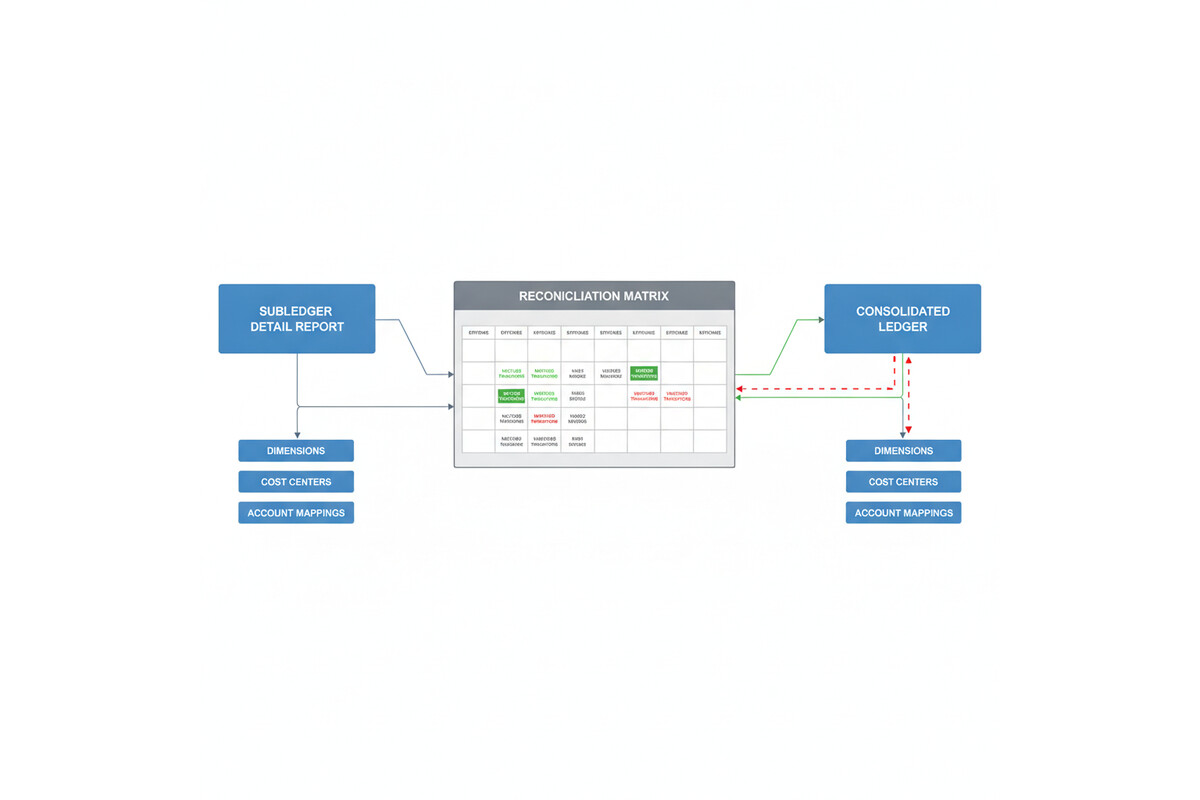
For organizations that absolutely require native consolidation, the paths are limited. Some choose to consolidate via Power BI Desktop, building the elimination logic in DAX measures and the data model, then publishing consolidated statements to a workspace. This works for companies willing to accept Power BI’s design constraints: limited support for large intercompany matrices, long refresh times if transaction volumes are high, and a reporting-only layer that does not feed back into GL for audit trail purposes. Others select a dedicated consolidation tool such as OneStream, Certent, Tableau, or Microsoft’s own Anaplan. The consolidation software becomes the single source of truth for group reporting, pulling operational data from BC instances and producing the consolidated financial statement. This creates a license cost external to BC, a separate user community, and a need to manage data integration and reconciliation between BC and the consolidation platform.
A third path, less common but increasingly pragmatic, is to implement BC only at the consolidated level and keep subsidiary ledgers in their existing systems. The parent company runs BC and reconciles to the subsidiary ledgers via month-end intercompany settlements rather than consolidating underlying GL detail. This works well for organizations that acquire mature, stable subsidiaries and want a clean integration without forcing migration. It requires a more complex intercompany/intersegment accounting setup in BC but avoids the consolidation feature gap entirely. The parent GL becomes the group GL, and subsidiaries report upward rather than consolidating downward.
The best practice for any organization evaluating BC for a multi-entity structure is to answer the consolidation question before implementation, not during. The CFO’s finance team should clearly define what consolidation means for their organization: Do they need elimination of intercompany transactions? Do they need IFRS 10 consolidation with minority interests? Will they require foreign exchange revaluation? Will they consolidate monthly, quarterly, or annually? Once the scope is clear, BC’s ability to support it is measurable. For organizations needing full consolidation with elimination logic and frequent reporting cycles, a dedicated tool is the right choice. For organizations needing rolled-up reporting from operationally separate entities with limited intercompany transactions, BC plus Power BI often suffices. For organizations running subsidiary ledgers as operational feeds to a parent BC company, BC alone works well. The critical mistake is assuming BC includes consolidation as a standard feature and discovering the gap after implementation begins.
Routeget Technologies regularly advises finance organizations on this trade-off. The organizations that achieve the smoothest multi-entity BC implementations are the ones that separate the operational ledger expectation from the consolidation expectation during vendor selection and architecture planning, rather than treating consolidation as a feature that should simply be there because D365 F&O includes it. BC’s architectural simplicity—what makes it fast and cost-effective for single-entity and straightforward multi-entity scenarios—is also what creates the consolidation feature boundary. Organizations that acknowledge and plan for that boundary find BC delivers real value; those that don’t often end up paying for a consolidation layer they didn’t budget for, installed alongside BC rather than within it.
Hashtags: #BusinessCentralConsolidation #MultiCompanyFinance #ConsolidationStrategy #FinanceOperations #ImplementationPlanning #CorporateFinance #AccountingAutomation