

The Business Central SOAP Retirement Deadline Is Closer Than It Looks
An IT director doing an annual vendor risk review recently found an integration nobody on her team remembered building. A bank feed connector, installed years earlier by a consultant who has long since moved on, was quietly pulling transaction data into Business Central through a SOAP endpoint pointed at a standard Microsoft page. It had run without incident since before her tenure started. The discovery only mattered because of one line buried in a Microsoft release note: that endpoint, and every other SOAP connection built the same way, stops working the moment Business Central version 29 reaches general availability in the first week of October 2026.
That is the practical shape of the Business Central SOAP retirement. It is not a single dramatic cutoff so much as the final step in a multi-year phase-out that a lot of IT teams filed away as a developer’s problem and never revisited. Microsoft introduced a feature key called “Disable SOAP web services on Microsoft UI pages” in the 2025 release wave 1 update, version 26, and it has been switched on by default ever since, blocking any new attempt to publish a standard Microsoft page as a SOAP endpoint. What made that default setting survivable for older integrations was the fact that an administrator could still go into Feature Management and turn the key back off, keeping the legacy behavior alive. Version 29 removes that feature key entirely. Once it is gone, there is no setting left to flip back on, and any integration still pointed at a Microsoft UI page over SOAP simply stops receiving responses.
The Business Central SOAP Retirement Only Touches Microsoft’s Own Pages
The scope here matters more than the deadline itself, because it is easy to overreact or underreact depending on how the news reaches you. What is actually being removed in version 29 is narrower than “SOAP support in Business Central.” Microsoft’s own justification, stated plainly in its developer documentation, is that a UI page was never designed to function as a stable API contract: a field can move, a control can be renamed, and none of that counts as a breaking change from Microsoft’s perspective, even though it can silently break an integration built directly against that page’s SOAP surface. So the retirement targets exactly that pattern: standard, out-of-the-box Microsoft pages exposed as SOAP web services.
Two other patterns are not affected by this particular change. SOAP endpoints built on codeunits keep working, since a codeunit is intentionally structured as a stable interface rather than a UI surface. SOAP endpoints built on custom, per-tenant extension pages also continue to function, because your organization controls that page’s schema and accepts responsibility for changes to it. If your integration inventory turns out to be built entirely on one of those two patterns, version 29 will not touch it. Many organizations, though, will find that at least one long-running integration, often the oldest one, was built the simple way: pointing directly at a Microsoft page because that was the path of least resistance when someone set it up years ago.
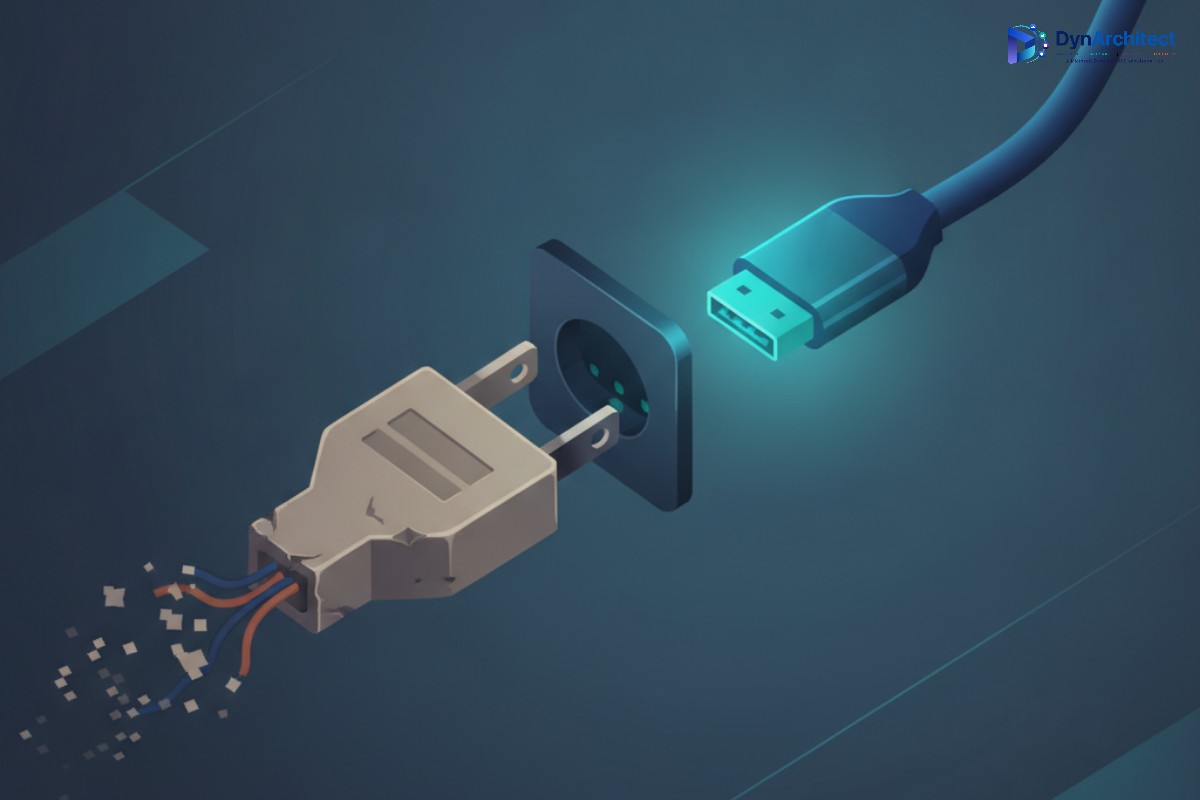
The Stopgap That Isn’t a Real Exemption
Microsoft’s own migration guidance includes an option that looks like an easy out: copy the source of the affected Microsoft page into a per-tenant extension, republish that copy as your own page, and expose the copy as a SOAP endpoint instead. Technically, this works, and it buys time without touching whatever consumes the integration on the other end. It is worth treating as exactly what it is, a stopgap, and not as a long-term architectural decision.
Two things argue against leaning on it permanently. First, you now own and maintain that copied page yourself, including any future logic changes Microsoft makes to the original that you will need to track and replicate by hand, which is precisely the maintenance burden the API-first approach was designed to avoid. Second, this is not the only deprecation moving through the same pipeline. Microsoft has already issued the equivalent warning for exposing Microsoft UI pages as OData endpoints, with removal currently targeted for the 2027 release wave 1 update, version 30. The pattern is consistent: UI-page-based web services of any protocol are being phased out in favor of purpose-built API pages and queries. A team that spends its 2026 budget re-platforming a SOAP integration onto a per-tenant extension, rather than onto a proper API page, is likely to be back doing similar work again in 2027 for the same underlying reason.
What This Means for Your Integration Portfolio
For a CIO or IT director, the practical risk is less about any single connector breaking and more about not knowing how many connectors exist in this pattern in the first place. SOAP-based integrations against Microsoft pages tend to cluster in a few high-value, low-visibility categories: bank statement and payment feeds set up early in an ERP implementation, EDI order intake with a long-standing trading partner, warehouse scanning or shop-floor tools built from an older sample or tutorial, and ISV add-ons purchased years ago from a vendor who may or may not have modernized their own connector since. None of these show up on a typical application inventory unless someone specifically goes looking for the transport protocol underneath them, which is exactly why this kind of deprecation tends to surface as an incident rather than as a planned project.
The financial exposure is concentrated, not diffuse. A broken bank feed means a manual reconciliation process returns overnight, right when finance least wants to discover it. A broken EDI intake means orders stop flowing from a partner who is unlikely to be sympathetic to an internal software upgrade as an excuse. Compare that to, say, a reporting dashboard built the same way, where a short outage is an inconvenience rather than a revenue event. Triage should follow that same logic: not every SOAP endpoint deserves equal urgency, but the ones tied to cash and order flow deserve attention well before the October deadline, not the week of it.
A Practical Sequence Before October
The starting point is visibility, not migration. Business Central logs incoming web service requests, and that telemetry can be pulled to show exactly which endpoints are being called, how often, and by page or codeunit type, before anyone commits engineering time to fixing something that may not even be at risk. From there, the sequence is straightforward in outline even if the execution takes real effort: separate the SOAP calls hitting Microsoft UI pages from those hitting codeunits or per-tenant extensions, since only the first category is on the clock; rank the affected integrations by business impact rather than by ease of fixing them, so a low-effort reporting connector does not quietly jump the queue ahead of a bank feed; and for anything ranked high, start the conversation with whoever owns the other end of the integration; internal developer, systems integrator, or third-party vendor, well before the release actually lands, since REST API pages or OData V4 endpoints for the same data may already exist and simply were never adopted when the integration was first built.
For integrations tied to a purchased ISV app, it is worth a direct question to the vendor rather than an assumption either way: ask specifically whether their connector talks to Business Central over SOAP against a standard page, and if so, what their own migration timeline looks like. A vendor who has not addressed this yet is effectively asking your organization to inherit their technical debt on their schedule, not yours.
Treat This as a Cleanup Project, Not a Fire Drill
The organizations that come out of this in good shape are the ones that treat the Business Central SOAP retirement as the forcing function for an integration inventory they should have had anyway, rather than as an isolated ticket to close before a deadline. We have seen the alternative version of this play out with prior Business Central deprecations: a scramble in the final weeks, a rushed fix that solves the immediate protocol problem without addressing the underlying design, and the same conversation repeating itself at the next deprecation cycle. Version 29 is a good moment to ask the larger question once, properly, rather than answering the narrow one twice.
#BusinessCentral #SOAPRetirement #ERPIntegration #APIModernization #IntegrationGovernance #DigitalTransformation





No comment yet, add your voice below!