The Forecast Nobody Trusts
Sales forecasts in enterprise organizations have a credibility problem. Sales leadership submits a forecast one month, management adjusts it downward out of habit, and by quarter-end everyone discovers that actual pipeline and close rates bore no resemblance to either number. The problem is not salespeople lying or poor spreadsheet discipline. It is that traditional forecasting relies on human judgment applied to datasets too large and complex for human pattern recognition to work reliably.
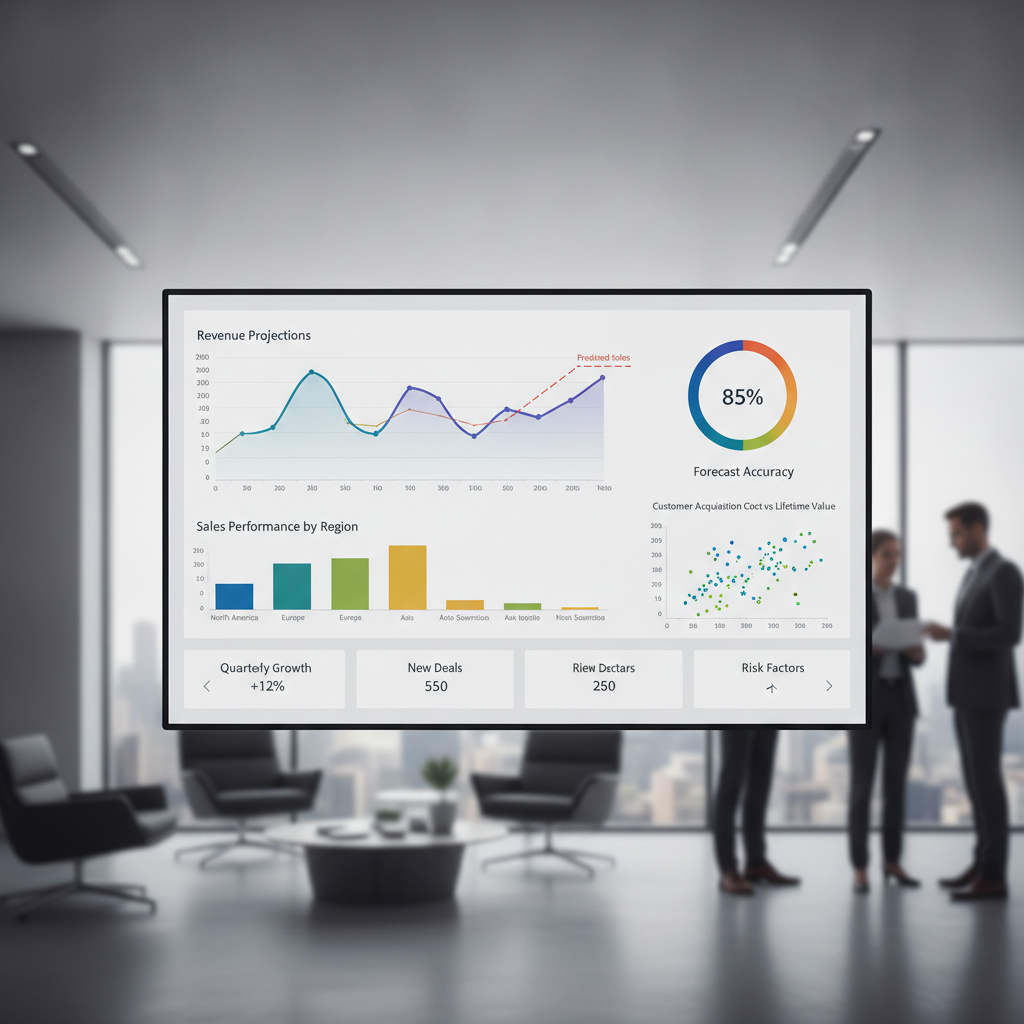
Dynamics 365 Sales with integrated AI and analytics capabilities changes this dynamic fundamentally. Rather than asking managers to estimate close rates and deal velocity based on their gut feel, organizations can build forecasts on the same historical data that actually predicts outcomes: past deal size, industry, pipeline velocity, sales rep experience, deal characteristics, and seasonal patterns. The result is not perfect, but it is consistently more accurate than traditional methods, and it gives sales leadership a fact-based foundation for revenue conversations with finance rather than negotiated guesses.
How Predictive Sales Analytics Work in Dynamics 365
Dynamics 365 Sales Premium includes a suite of analytics capabilities that power forecasting without requiring advanced data science skills or external platforms. The system automatically ingests data from opportunity records, activities, customer accounts, and deal attributes, then uses machine learning to identify the patterns that correlate with closed wins, lost deals, and extended cycles.
For an organization selling enterprise software with typical sales cycles of six to nine months, the system learns that deals from specific industries have different close rates, that proposals sent in month two (as opposed to month four) have higher win probability, and that opportunities touching more buying committee contacts are more likely to close. These patterns are statistically significant but often invisible to human judgment operating over dozens or hundreds of deals simultaneously.
The forecasting engine generates a confidence score for each opportunity: a prediction of the probability that deal will close within the target quarter. Rather than replacing the salesperson’s forecast with an algorithm, Dynamics 365 surfaces these predictions as a recommendation layer, allowing sales managers to keep the deal in forecast if they believe factors not in the data justify it, or to flag deals where the algorithm’s assessment contradicts the sales rep’s estimate. In practice, deals the system rates as low-probability but the rep insists will close become visible decision points, and forecasts weighted by these probabilities prove more accurate than unadjusted rep estimates.
Moving from Monthly Submissions to Continuous Intelligence
Traditional sales forecasting operates on a monthly or quarterly cadence. Sales leaders call a forecast meeting, reps submit their estimates, managers apply adjustments, and the number goes to finance. Three weeks later, when actual deals close or new opportunities surface, the forecast is already outdated.
AI-driven forecasting in Dynamics 365 Sales operates continuously. As pipeline changes, deal characteristics evolve, and close dates shift, the system recalculates probability scores in real time. Sales leadership can check accuracy at any point in the quarter rather than waiting for the official review, and can identify where actual progress is diverging from forecast early enough to adjust strategy or pipeline development.
This shift from periodic submission to continuous intelligence has operational consequences. Sales managers no longer spend two days in forecast-call meetings; instead they spend fifteen minutes reviewing a dashboard that shows which deals are tracking as expected and which have shifted risk status. Finance gets a more current picture of expected revenue. And sales reps see their opportunities scored fairly against consistent criteria rather than subject to manager judgment that varies month to month.
Building Revenue Predictability Across Market Segments
One of the highest-value uses of predictive sales analytics is building segment-specific forecast models. An organization selling both managed services and perpetual licenses may discover that customers purchasing managed services have a seventy-percent close rate while perpetual license deals close at forty-five percent, and that rep tenure affects close rates only for managed services, not perpetual deals. Once these segment-specific patterns are identified, forecasts weighted by segment become far more accurate than a single organization-wide model.
Organizations with international operations benefit further, as the system can identify which regions have different sales dynamics. A deal structure that works reliably in North America may have lower success in Asia Pacific due to buying patterns or competitive dynamics, and a forecast that does not account for that regional signal will consistently overshoot certain markets and undershoot others.
Building these segment models requires data discipline (opportunity fields must be filled consistently, sales stages must be defined clearly), but once that foundation is in place, the system automatically detects and incorporates segment-specific patterns. Sales organizations that have historically managed separate forecast models for different markets often find they can consolidate to a single system with segment-driven weightings, reducing forecast maintenance overhead while improving overall accuracy.
Common Implementation Mistakes
Organizations implementing AI-driven forecasting in Dynamics 365 Sales often make three systematic mistakes. First, they attempt to train the model on too little historical data. If the system only has two quarters of opportunity records, it cannot detect patterns that matter for a deal type with an eighteen-month cycle. Second, they do not invest in data quality upstream. If opportunity records lack consistent stage definitions, industry classifications, or customer size information, the model has no signal to work with. Third, they present the AI forecast as a replacement for human judgment rather than as a tool that surfaces patterns human judgment can integrate. Sales organizations that frame the system as “the computer will tell you who to trust” face adoption resistance; those that frame it as “the system flags patterns you should investigate” see adoption and engagement.
Next Steps for Sales Leadership
For organizations already using Dynamics 365 Sales, enabling predictive analytics is typically a configuration matter rather than a deployment project. Assess your historical opportunity data to confirm you have at least four quarters available and that field completion rates are reasonable. Review your sales stage definitions to ensure they are consistent with how deals actually progress. Then enable the analytics features and begin building segment-specific forecast models based on your business lines.
For organizations evaluating Dynamics 365 Sales or planning major system migrations, AI-driven forecasting should be part of the evaluation criteria. Whether your organization benefits from this capability depends on your sales model, your forecast accuracy needs, and your data discipline, but for enterprises where forecast accuracy directly affects financial planning and capital allocation, predictive sales analytics often justify the platform investment on their own.
The Forecast Everyone Uses
The strategic value of AI-driven forecasting extends beyond raw accuracy. When sales leadership and finance can trust a forecast because it is grounded in historical data rather than negotiation, conversations shift. Instead of debating the number, the conversation becomes, “What actions should we take to shift close rates or deal velocity?” Sales and finance become partners in building pipeline rather than adversaries in a forecast negotiation.
Dynamics 365 Sales with integrated AI analytics makes this shift possible. For sales organizations ready to move beyond spreadsheet-based forecasting, the capability is available today.
About Routeget Technologies: Routeget Technologies helps mid-market and enterprise organizations implement and optimize Dynamics 365 Sales, enabling teams to improve forecast accuracy, streamline pipeline management, and drive predictable revenue growth through data-driven sales practices.
#SalesForecastingAI #DynamicsSalesAnalytics #SalesRevenuePlanning #PredictiveAnalyticsD365 #SalesLeadership #EnterpriseAI #DynamicsSales
No comment yet, add your voice below!