Predictive Sales Pipeline: Using AI-Driven Insights to Close Deals Faster in Dynamics 365 Sales

The Forecast Accuracy Problem

Your sales forecast is off by 35 percent. Again. The finance team wants to know next quarter’s revenue within two percent, but your pipeline visibility stops at whether deals exist and how long they’ve been sitting in “negotiation.” You look at spreadsheet tabs from regional managers, each with their own methodology for sizing opportunities and predicting close probability. Some are optimistic, some conservative, none consistent. The disconnect costs real money: cash-flow planning misfires, resource allocation goes sideways, and your board stops trusting the numbers you present.

This scenario repeats across thousands of organizations. Sales leaders inherit forecasting processes that depend entirely on deal volume and a manager’s intuition about velocity. The problem has always been that forecasting requires insight into factors spreadsheets cannot track: how engaged the decision-maker actually is, whether objections have real weight or are routine hesitation, how similar past deals progressed at this exact stage. Collecting that data manually, standardizing it across teams, and applying consistent logic to it exceeds human capacity, especially in enterprises where one forecast might pull together hundreds of open deals across multiple regions.

Dynamics 365 Sales now addresses this directly through predictive analytics built on explainable artificial intelligence. Rather than guess, sales leaders can make pipeline decisions grounded in pattern recognition across historical deal data, engagement signals, and real-time opportunity activity.

How Predictive Analytics Works in Practice

The approach sounds technical but operates transparently. Predictive AI in Dynamics 365 Sales analyzes two key data sources. First, it examines the historical record: past opportunities that closed won or lost, along with every attribute recorded in the CRM during their lifecycle (deal value, customer segment, sales stage, stage velocity, engagement patterns from email and meetings). Second, it observes real-time signals on current opportunities: activity frequency, meeting attendance, email responsiveness, and how quickly deals advance from stage to stage relative to historical norms.

The engine then calculates win probability, churn risk, renewal likelihood, or whatever outcome metric the organization defines. Critically, it explains its reasoning. A prediction of “72 percent win probability” becomes useless without context. But “72 percent because deal value and decision-maker engagement align with past high-probability patterns, though stage velocity trails historical norms” tells a manager something actionable: close timing may slip, but the deal has substance.

This explainability matters enormously to adoption. Sales teams that see black-box scores distrust them. Teams that understand why a deal scores 62 percent instead of 78 percent can act on the gap.

Business Outcomes Worth the Investment

The quantified benefits are substantial. Organizations that implement predictive analytics in Dynamics 365 Sales typically see a 20 to 30 percent reduction in forecast error compared to spreadsheet-driven methods. This translates directly into better cash-flow predictability for finance, more accurate revenue recognition for reporting, and fewer surprises for your board and investors. Some organizations report forecast accuracy improvement of up to 75 percent when moving from intuition-based forecasting to data-backed predictions.

Beyond accuracy, predictive analytics reshapes how sales leadership works. Instead of managing pipeline by volume (“we have 40 open deals worth $8 million”), managers manage by probability and risk (“we have $5.2 million in high-probability deals, $2.1 million at moderate risk, and $700k that needs intervention or should be re-evaluated”). This clarity enables coaching at scale: rather than react when deals slip or close unexpectedly, leaders proactively identify deals moving slower than historical patterns and intervene with targeted support.

Resource allocation improves. When you know which opportunities have the highest win probability relative to effort required, you can direct your best sales reps toward deals with maximum impact potential rather than distributing effort evenly across the pipeline. This is especially valuable for complex enterprise sales where a single rep’s productivity on a high-probability deal can shift quarterly results significantly.

Addressing the Adoption Challenge

Predictive analytics only delivers value if sales teams actually use it. This requires three foundational elements. First, data quality must be real. Garbage predictions come from garbage data. If your sales team is not consistently updating deal stage, recording meeting outcomes, or noting objections, predictive accuracy collapses. Organizations typically spend 4 to 8 weeks ensuring data hygiene before meaningful predictions emerge.

Second, the organization must define what outcomes matter. Dynamics 365 Sales allows you to build different prediction models for different deal types or customer segments. A 2 million dollar software license renewal may have completely different win indicators than a 50 thousand dollar managed services deal. Rather than force one model on both, segment your training data and let AI understand the patterns unique to each. This requires your sales and operations team to think deliberately about what “high-probability” means for their business, not just accept a default.

Third, sales leadership must reinforce the behaviors that improve predictions. If predictive scores show a deal at 48 percent win probability but no rep is taking action on that signal, predictions become noise. Tie rep performance reviews, deal reviews, and sales coaching to signals from predictive analytics, and reps will pay attention. Use the explanations as coaching tools: “Your engagement signal is tracking 15 percent below deals that close at this stage. What’s blocking the buyer’s internal process?”

Practical Implementation Starting Point

Most organizations begin with predictive win probability on their largest opportunities, since high-value deals justify investment in improving forecasting accuracy. Start there, let your team build confidence in the model for 60 to 90 days, then expand to other deal types or predictive outcomes such as churn risk on renewals or ramp time on new customer accounts.

Expect your IT team to validate that Dynamics 365 Sales predictive capabilities align with your governance and compliance requirements, especially around data retention, model transparency, and audit trails. The AI here is not a black box: you can inspect model factors, understand how historical data shaped predictions, and audit decision-making.

The investment required is typically modest. Predictive analytics comes built into Dynamics 365 Sales licensing; additional tooling costs depend on whether you want third-party extensions or need custom prediction models for highly unique deal types. Most returns come from better decisions rather than new infrastructure.

Moving Past Spreadsheet Forecasting

Sales forecasting remains one of the few business processes where most enterprises still rely on manual aggregation and management judgment. Organizations that have modernized forecasting to data-backed predictions consistently report that their board conversations shift. Instead of debating whether a forecast is real or inflated, conversations center on what factors are causing deal velocity to track below or above historical norms and what actions the sales organization should take in response.

Predictive analytics in Dynamics 365 Sales makes this shift possible. It transforms pipeline data from a static snapshot into a continuous source of strategic insight, enabling sales leaders to allocate resources toward high-probability opportunities, identify and coach deals at risk, and deliver forecasts that finance can rely on for planning. For organizations frustrated with forecast accuracy, the improvement is not incremental. It is substantial enough that some CIOs and CFOs view it as a primary driver of the value of Dynamics 365 Sales itself.


Routeget Technologies helps enterprise organizations implement sales-driven Dynamics 365 solutions that connect pipeline visibility with revenue predictability. Our consulting teams have guided forecasting modernization for organizations across manufacturing, distribution, and professional services sectors, ensuring predictive analytics implementations drive both adoption and business results.


#DynamicsSalesAI #PredictivePipeline #SalesForecasting #SalesCloud #DynamicsInsights #CRMStrategy #SalesLeadership

AI-Powered Sales Forecasting in Dynamics 365 Sales: From Historical Data to Predictive Revenue Planning

The Forecast Nobody Trusts

Sales forecasts in enterprise organizations have a credibility problem. Sales leadership submits a forecast one month, management adjusts it downward out of habit, and by quarter-end everyone discovers that actual pipeline and close rates bore no resemblance to either number. The problem is not salespeople lying or poor spreadsheet discipline. It is that traditional forecasting relies on human judgment applied to datasets too large and complex for human pattern recognition to work reliably.

Dynamics 365 Sales with integrated AI and analytics capabilities changes this dynamic fundamentally. Rather than asking managers to estimate close rates and deal velocity based on their gut feel, organizations can build forecasts on the same historical data that actually predicts outcomes: past deal size, industry, pipeline velocity, sales rep experience, deal characteristics, and seasonal patterns. The result is not perfect, but it is consistently more accurate than traditional methods, and it gives sales leadership a fact-based foundation for revenue conversations with finance rather than negotiated guesses.

How Predictive Sales Analytics Work in Dynamics 365

Dynamics 365 Sales Premium includes a suite of analytics capabilities that power forecasting without requiring advanced data science skills or external platforms. The system automatically ingests data from opportunity records, activities, customer accounts, and deal attributes, then uses machine learning to identify the patterns that correlate with closed wins, lost deals, and extended cycles.

For an organization selling enterprise software with typical sales cycles of six to nine months, the system learns that deals from specific industries have different close rates, that proposals sent in month two (as opposed to month four) have higher win probability, and that opportunities touching more buying committee contacts are more likely to close. These patterns are statistically significant but often invisible to human judgment operating over dozens or hundreds of deals simultaneously.

The forecasting engine generates a confidence score for each opportunity: a prediction of the probability that deal will close within the target quarter. Rather than replacing the salesperson’s forecast with an algorithm, Dynamics 365 surfaces these predictions as a recommendation layer, allowing sales managers to keep the deal in forecast if they believe factors not in the data justify it, or to flag deals where the algorithm’s assessment contradicts the sales rep’s estimate. In practice, deals the system rates as low-probability but the rep insists will close become visible decision points, and forecasts weighted by these probabilities prove more accurate than unadjusted rep estimates.

Moving from Monthly Submissions to Continuous Intelligence

Traditional sales forecasting operates on a monthly or quarterly cadence. Sales leaders call a forecast meeting, reps submit their estimates, managers apply adjustments, and the number goes to finance. Three weeks later, when actual deals close or new opportunities surface, the forecast is already outdated.

AI-driven forecasting in Dynamics 365 Sales operates continuously. As pipeline changes, deal characteristics evolve, and close dates shift, the system recalculates probability scores in real time. Sales leadership can check accuracy at any point in the quarter rather than waiting for the official review, and can identify where actual progress is diverging from forecast early enough to adjust strategy or pipeline development.

This shift from periodic submission to continuous intelligence has operational consequences. Sales managers no longer spend two days in forecast-call meetings; instead they spend fifteen minutes reviewing a dashboard that shows which deals are tracking as expected and which have shifted risk status. Finance gets a more current picture of expected revenue. And sales reps see their opportunities scored fairly against consistent criteria rather than subject to manager judgment that varies month to month.

Building Revenue Predictability Across Market Segments

One of the highest-value uses of predictive sales analytics is building segment-specific forecast models. An organization selling both managed services and perpetual licenses may discover that customers purchasing managed services have a seventy-percent close rate while perpetual license deals close at forty-five percent, and that rep tenure affects close rates only for managed services, not perpetual deals. Once these segment-specific patterns are identified, forecasts weighted by segment become far more accurate than a single organization-wide model.

Organizations with international operations benefit further, as the system can identify which regions have different sales dynamics. A deal structure that works reliably in North America may have lower success in Asia Pacific due to buying patterns or competitive dynamics, and a forecast that does not account for that regional signal will consistently overshoot certain markets and undershoot others.

Building these segment models requires data discipline (opportunity fields must be filled consistently, sales stages must be defined clearly), but once that foundation is in place, the system automatically detects and incorporates segment-specific patterns. Sales organizations that have historically managed separate forecast models for different markets often find they can consolidate to a single system with segment-driven weightings, reducing forecast maintenance overhead while improving overall accuracy.

Common Implementation Mistakes

Organizations implementing AI-driven forecasting in Dynamics 365 Sales often make three systematic mistakes. First, they attempt to train the model on too little historical data. If the system only has two quarters of opportunity records, it cannot detect patterns that matter for a deal type with an eighteen-month cycle. Second, they do not invest in data quality upstream. If opportunity records lack consistent stage definitions, industry classifications, or customer size information, the model has no signal to work with. Third, they present the AI forecast as a replacement for human judgment rather than as a tool that surfaces patterns human judgment can integrate. Sales organizations that frame the system as “the computer will tell you who to trust” face adoption resistance; those that frame it as “the system flags patterns you should investigate” see adoption and engagement.

Next Steps for Sales Leadership

For organizations already using Dynamics 365 Sales, enabling predictive analytics is typically a configuration matter rather than a deployment project. Assess your historical opportunity data to confirm you have at least four quarters available and that field completion rates are reasonable. Review your sales stage definitions to ensure they are consistent with how deals actually progress. Then enable the analytics features and begin building segment-specific forecast models based on your business lines.

For organizations evaluating Dynamics 365 Sales or planning major system migrations, AI-driven forecasting should be part of the evaluation criteria. Whether your organization benefits from this capability depends on your sales model, your forecast accuracy needs, and your data discipline, but for enterprises where forecast accuracy directly affects financial planning and capital allocation, predictive sales analytics often justify the platform investment on their own.

The Forecast Everyone Uses

The strategic value of AI-driven forecasting extends beyond raw accuracy. When sales leadership and finance can trust a forecast because it is grounded in historical data rather than negotiation, conversations shift. Instead of debating the number, the conversation becomes, “What actions should we take to shift close rates or deal velocity?” Sales and finance become partners in building pipeline rather than adversaries in a forecast negotiation.

Dynamics 365 Sales with integrated AI analytics makes this shift possible. For sales organizations ready to move beyond spreadsheet-based forecasting, the capability is available today.


About Routeget Technologies: Routeget Technologies helps mid-market and enterprise organizations implement and optimize Dynamics 365 Sales, enabling teams to improve forecast accuracy, streamline pipeline management, and drive predictable revenue growth through data-driven sales practices.

#SalesForecastingAI #DynamicsSalesAnalytics #SalesRevenuePlanning #PredictiveAnalyticsD365 #SalesLeadership #EnterpriseAI #DynamicsSales

Revenue Leakage in Dynamics 365 Sales: How Customer Insights Reveals the Customers and Deals Your Sales Team Is Overlooking

Sales analytics dashboard showing customer data, revenue trends, and risk indicators

Every sales leader knows the tension: your forecast shows healthy pipeline, yet deals slip, renewal customers disappear, and you discover too late that a key account has been quietly moving spend to a competitor. By then, the revenue is gone. The uncomfortable truth is that most sales organizations are missing revenue opportunities because they lack complete visibility into customer health. Dynamics 365 Sales gives you the transaction history, but it doesn’t automatically tell you which customers are at churn risk, which territories are underserving high-value segments, or which accounts have unmet needs your sales team has overlooked.

This visibility gap creates revenue leakage—the silent drain of money your organization should be capturing but isn’t. It’s not a process problem or a capability problem. It’s a data problem. Sales teams today operate with fragmented customer views, pulling insights from email, spreadsheets, and half-remembered conversations rather than from a unified, AI-informed customer profile.

Dynamics 365 Customer Insights, integrated with Dynamics 365 Sales, changes that equation. It surfaces the customer and deal patterns your sales team is missing, turning reactive forecasting into proactive opportunity identification. Here’s why this matters, and how to use it.

The Hidden Cost of Incomplete Customer Visibility

A typical enterprise sales organization manages accounts across multiple product lines, regions, and sales representatives. Within that sprawl, visibility breaks down. A customer’s service interactions, support history, and product usage patterns live in separate systems. Your CRM captures what the sales team recorded, often days or weeks after the conversation. Marketing knows about digital engagement and content downloads but doesn’t automatically share that with the sales team. Finance sees transaction history but not the potential for expansion.

The result is that your sales team operates on a partial picture. A renewal customer who shows declining product usage may not trigger an alert until the renewal comes due—too late to course-correct. A high-value prospect showing strong product engagement may never get the right follow-up because the sales process doesn’t connect product behavior to account value. A territory might be systematically underserving customers in a high-margin segment simply because the data to identify those customers never reaches the account manager’s workspace.

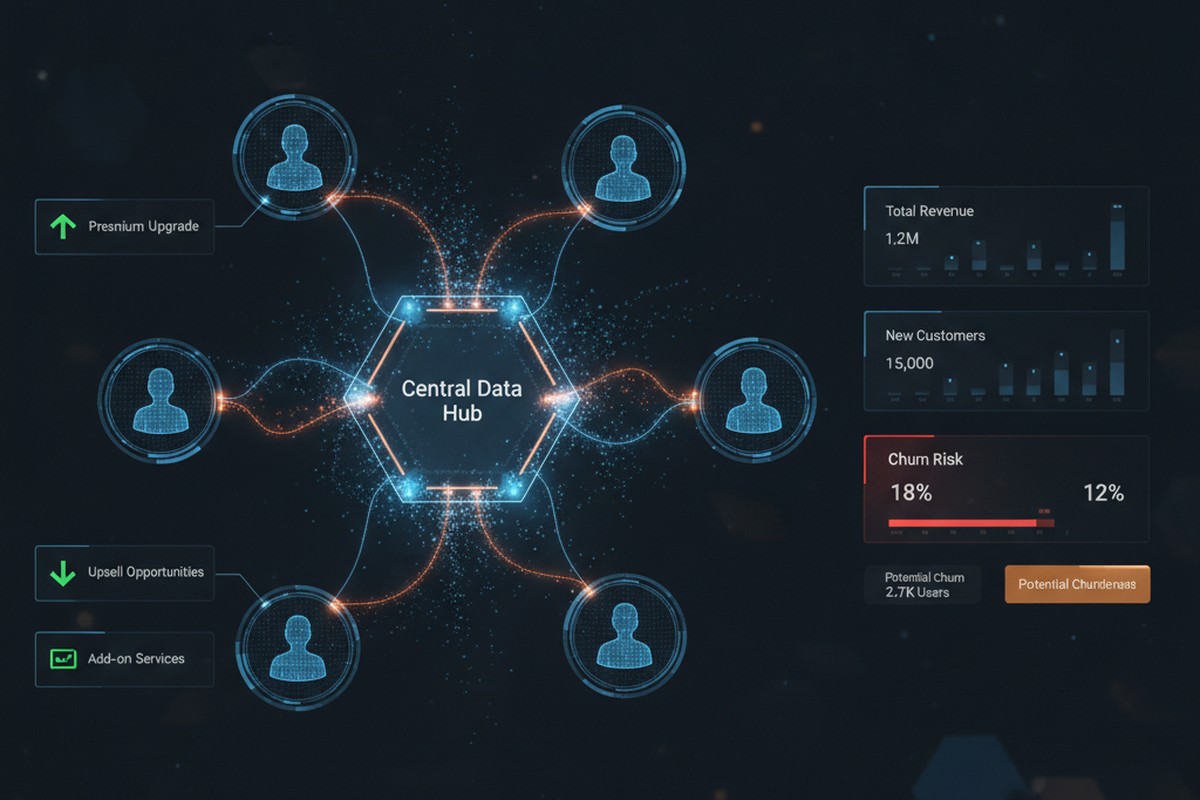
Customer insights and sales analytics visualization showing interconnected customer data, churn risk indicators, and upsell opportunities

None of these problems are individually dramatic. But they accumulate. A single missed upsell here, a renewal at risk there, a territory misaligned by segment. Over a year, across a 50-person or 500-person sales organization, the revenue impact becomes material. This is revenue leakage: money your organization should capture but doesn’t because the visibility isn’t there to act on it.

What Customer Insights Reveals

Dynamics 365 Customer Insights does three things that Dynamics 365 Sales alone cannot do: it unifies fragmented data, it applies AI to detect patterns, and it surfaces those patterns directly where sales works.

First, unification. Customer Insights pulls data from Dynamics 365 Sales, Service, and Finance, along with external sources like transactional systems, email engagement platforms, and even product usage telemetry if you’re licensing that data. It resolves duplicate customer records, maps fragmented customer identities across systems, and builds a single unified customer profile. That profile then becomes the source of truth for your sales team, not the sum of dozens of disconnected systems.

Second, AI-driven pattern detection. Once your customer data is unified, Customer Insights applies machine learning models to detect risk and opportunity. It identifies which customers are at churn risk based on behavioral signals: declining engagement, reduced transaction frequency, increasing support tickets for infrastructure issues rather than feature adoption. It flags cross-sell and upsell candidates by finding customers with strong product engagement, high contract value, and similarity to customers who have successfully adopted adjacent products. It detects territory misalignment by showing which high-value customer segments are under-represented in each territory’s current assignment.

Third, integration into sales workflows. Customer Insights insights aren’t buried in a separate analytics portal. They live inside Dynamics 365 Sales, where your sales team already works. A segment insight becomes a targeted list for account managers. A churn risk indicator appears on the customer card, prompting a proactive outreach. Territory realignment recommendations come with data backing that makes the business case clear to sales leadership.

Three Revenue Leaks Customer Insights Stops

In practice, this surfaces three common revenue leaks that Dynamics 365 Sales alone doesn’t catch.

Churn risk not detected until renewal: A customer’s service organization starts requesting more support tickets. Their product usage plateaus. They haven’t attended your quarterly business reviews. But your sales team doesn’t know this yet because the renewal isn’t for eight months. By the time the renewal date arrives, the customer has already decided to leave. Customer Insights detects these behavioral signals and flags the account as at-risk, giving your sales team months to engage, understand the underlying issues, and propose solutions before the customer decides to leave.

Upsell and cross-sell opportunities invisible in transaction history: An existing customer has been steadily growing revenue with one product line. Their usage of that product is high relative to their segment peer group. They have no adoption of your complementary product, despite a clear business case. But this pattern doesn’t surface in your CRM unless a sales rep manually reviews the account and spots it. Customer Insights identifies customers matching this profile (high engagement with Product A, zero adoption of Product B, high segment value) and presents the opportunity to the account manager in a curated list. The sales team then has clear targeting and clear messaging: here are ten accounts that look exactly like your most successful cross-sell deals.

Territory assignments that systematically underserve high-value segments: A sales rep covers a territory by geography or existing customer base, as most do. But unbeknownst to anyone, their territory is underindexed for your highest-margin customer segment. There are five high-value customers they should be servicing more aggressively, but the assignment wasn’t based on segment data. Customer Insights analyzes territory composition and identifies these gaps. Sales leadership can then realign assignments, pair reps, or adjust compensation to prioritize the underserved segment, recovering revenue that was never really lost but never properly prioritized either.

Making It Work: Implementation Reality

Deploying Customer Insights for revenue recovery requires more than licensing and configuration. It requires discipline around data and alignment between sales and the teams supporting data quality.

Start narrow. Don’t try to build a unified customer profile from all your data at once. Pick your three to five highest-priority leakage patterns: churn risk, a specific high-margin upsell use case, or territory underutilization in a specific segment. Build the data foundation for those patterns first. That usually means cleaning Dynamics 365 Sales and Finance data, establishing integrations with service and support systems, and clarifying the business definitions your models need (what signals constitute churn risk for your product and industry, what engagement level constitutes strong adoption, what segments you care most about).

Then connect insights to action. An insight that doesn’t make it to a sales rep’s attention is just reporting. Customer Insights insights should flow into Dynamics 365 Sales as filtered lists, dynamic segments, or automated workflow triggers. When a customer hits a churn-risk threshold, a task appears on the account manager’s dashboard. When your AI identifies a cross-sell candidate, it lands in a weekly opportunity list. This requires configuration, but it’s configuration that makes the investment pay off.

Finally, track adoption and adjust. Sales teams don’t automatically trust new data. They trust data that repeatedly surfaces patterns they already sense. So measure: what percentage of churn-risk customers your team engages, what percentage of AI-identified cross-sell opportunities convert, what revenue the territory realignment recovered. As results emerge, adoption increases and the business case for the investment becomes clear.

The Compound Effect

Revenue leakage seems invisible because it’s measured by the opportunities you didn’t see, not by the deals you lost. A customer renewal that didn’t happen looks like a churn, not a miss. A customer segment your territory didn’t pursue looks like normal variation in segment mix, not a systemic gap. But when you unify customer data and apply AI to detect patterns, these invisible leaks become visible. And visible problems are fixable.

For a 100-person sales organization with average deal size of $50,000, recovering even one additional deal per quarter per rep through improved territory alignment or churn prevention represents $5M to $10M in annual recurring revenue. The math compounds as your organization scales. Customer Insights is not the only solution to revenue leakage, but it’s one of the few tools that surface the patterns causing the leak in the first place.

Dynamics 365 Sales will always show you what happened. Customer Insights shows you what you’re missing. For sales leaders serious about revenue recovery, that difference is strategic.


About Routeget Technologies: Routeget specializes in Dynamics 365 implementations for enterprise sales and service organizations. We help sales leaders establish data governance and customer analytics strategies that uncover revenue recovery opportunities through Customer Insights and Dynamics 365 Sales integration. If your organization is looking to reduce revenue leakage through better customer intelligence, we’d welcome a conversation.

#DynamicsSales #CustomerInsights #RevenueLeakage #SalesAnalytics #SalesForecasting #CustomerDataPlatform #SalesLeadership