The Forecast Accuracy Problem
Your sales forecast is off by 35 percent. Again. The finance team wants to know next quarter’s revenue within two percent, but your pipeline visibility stops at whether deals exist and how long they’ve been sitting in “negotiation.” You look at spreadsheet tabs from regional managers, each with their own methodology for sizing opportunities and predicting close probability. Some are optimistic, some conservative, none consistent. The disconnect costs real money: cash-flow planning misfires, resource allocation goes sideways, and your board stops trusting the numbers you present.
This scenario repeats across thousands of organizations. Sales leaders inherit forecasting processes that depend entirely on deal volume and a manager’s intuition about velocity. The problem has always been that forecasting requires insight into factors spreadsheets cannot track: how engaged the decision-maker actually is, whether objections have real weight or are routine hesitation, how similar past deals progressed at this exact stage. Collecting that data manually, standardizing it across teams, and applying consistent logic to it exceeds human capacity, especially in enterprises where one forecast might pull together hundreds of open deals across multiple regions.
Dynamics 365 Sales now addresses this directly through predictive analytics built on explainable artificial intelligence. Rather than guess, sales leaders can make pipeline decisions grounded in pattern recognition across historical deal data, engagement signals, and real-time opportunity activity.
How Predictive Analytics Works in Practice
The approach sounds technical but operates transparently. Predictive AI in Dynamics 365 Sales analyzes two key data sources. First, it examines the historical record: past opportunities that closed won or lost, along with every attribute recorded in the CRM during their lifecycle (deal value, customer segment, sales stage, stage velocity, engagement patterns from email and meetings). Second, it observes real-time signals on current opportunities: activity frequency, meeting attendance, email responsiveness, and how quickly deals advance from stage to stage relative to historical norms.
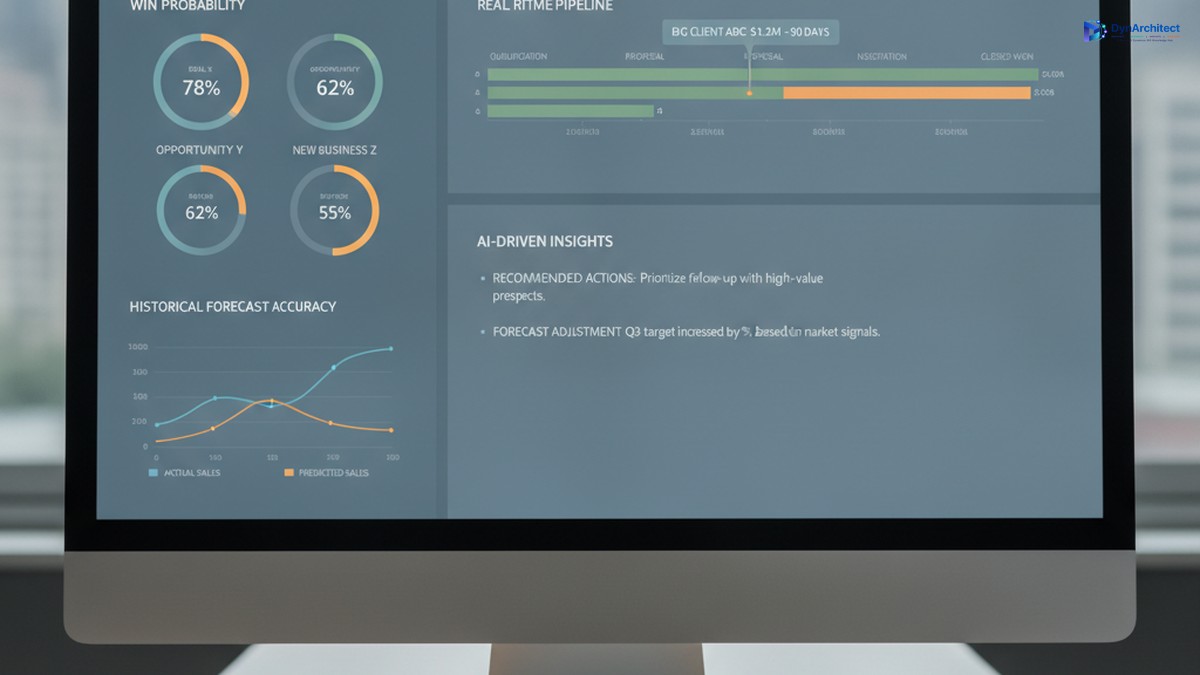
The engine then calculates win probability, churn risk, renewal likelihood, or whatever outcome metric the organization defines. Critically, it explains its reasoning. A prediction of “72 percent win probability” becomes useless without context. But “72 percent because deal value and decision-maker engagement align with past high-probability patterns, though stage velocity trails historical norms” tells a manager something actionable: close timing may slip, but the deal has substance.
This explainability matters enormously to adoption. Sales teams that see black-box scores distrust them. Teams that understand why a deal scores 62 percent instead of 78 percent can act on the gap.
Business Outcomes Worth the Investment
The quantified benefits are substantial. Organizations that implement predictive analytics in Dynamics 365 Sales typically see a 20 to 30 percent reduction in forecast error compared to spreadsheet-driven methods. This translates directly into better cash-flow predictability for finance, more accurate revenue recognition for reporting, and fewer surprises for your board and investors. Some organizations report forecast accuracy improvement of up to 75 percent when moving from intuition-based forecasting to data-backed predictions.
Beyond accuracy, predictive analytics reshapes how sales leadership works. Instead of managing pipeline by volume (“we have 40 open deals worth $8 million”), managers manage by probability and risk (“we have $5.2 million in high-probability deals, $2.1 million at moderate risk, and $700k that needs intervention or should be re-evaluated”). This clarity enables coaching at scale: rather than react when deals slip or close unexpectedly, leaders proactively identify deals moving slower than historical patterns and intervene with targeted support.
Resource allocation improves. When you know which opportunities have the highest win probability relative to effort required, you can direct your best sales reps toward deals with maximum impact potential rather than distributing effort evenly across the pipeline. This is especially valuable for complex enterprise sales where a single rep’s productivity on a high-probability deal can shift quarterly results significantly.
Addressing the Adoption Challenge
Predictive analytics only delivers value if sales teams actually use it. This requires three foundational elements. First, data quality must be real. Garbage predictions come from garbage data. If your sales team is not consistently updating deal stage, recording meeting outcomes, or noting objections, predictive accuracy collapses. Organizations typically spend 4 to 8 weeks ensuring data hygiene before meaningful predictions emerge.
Second, the organization must define what outcomes matter. Dynamics 365 Sales allows you to build different prediction models for different deal types or customer segments. A 2 million dollar software license renewal may have completely different win indicators than a 50 thousand dollar managed services deal. Rather than force one model on both, segment your training data and let AI understand the patterns unique to each. This requires your sales and operations team to think deliberately about what “high-probability” means for their business, not just accept a default.
Third, sales leadership must reinforce the behaviors that improve predictions. If predictive scores show a deal at 48 percent win probability but no rep is taking action on that signal, predictions become noise. Tie rep performance reviews, deal reviews, and sales coaching to signals from predictive analytics, and reps will pay attention. Use the explanations as coaching tools: “Your engagement signal is tracking 15 percent below deals that close at this stage. What’s blocking the buyer’s internal process?”
Practical Implementation Starting Point
Most organizations begin with predictive win probability on their largest opportunities, since high-value deals justify investment in improving forecasting accuracy. Start there, let your team build confidence in the model for 60 to 90 days, then expand to other deal types or predictive outcomes such as churn risk on renewals or ramp time on new customer accounts.
Expect your IT team to validate that Dynamics 365 Sales predictive capabilities align with your governance and compliance requirements, especially around data retention, model transparency, and audit trails. The AI here is not a black box: you can inspect model factors, understand how historical data shaped predictions, and audit decision-making.
The investment required is typically modest. Predictive analytics comes built into Dynamics 365 Sales licensing; additional tooling costs depend on whether you want third-party extensions or need custom prediction models for highly unique deal types. Most returns come from better decisions rather than new infrastructure.
Moving Past Spreadsheet Forecasting
Sales forecasting remains one of the few business processes where most enterprises still rely on manual aggregation and management judgment. Organizations that have modernized forecasting to data-backed predictions consistently report that their board conversations shift. Instead of debating whether a forecast is real or inflated, conversations center on what factors are causing deal velocity to track below or above historical norms and what actions the sales organization should take in response.
Predictive analytics in Dynamics 365 Sales makes this shift possible. It transforms pipeline data from a static snapshot into a continuous source of strategic insight, enabling sales leaders to allocate resources toward high-probability opportunities, identify and coach deals at risk, and deliver forecasts that finance can rely on for planning. For organizations frustrated with forecast accuracy, the improvement is not incremental. It is substantial enough that some CIOs and CFOs view it as a primary driver of the value of Dynamics 365 Sales itself.
Routeget Technologies helps enterprise organizations implement sales-driven Dynamics 365 solutions that connect pipeline visibility with revenue predictability. Our consulting teams have guided forecasting modernization for organizations across manufacturing, distribution, and professional services sectors, ensuring predictive analytics implementations drive both adoption and business results.
#DynamicsSalesAI #PredictivePipeline #SalesForecasting #SalesCloud #DynamicsInsights #CRMStrategy #SalesLeadership
No comment yet, add your voice below!