
Most finance teams have spent years building cash flow forecasts in Excel, stitching together data from bank statements, accounts payable systems, and revenue pipelines into spreadsheets that someone updates manually every month. The work is repetitive, the data silos make it unreliable, and by the time the forecast is finished, half of it is already stale. Dynamics 365 Finance Insights offers an escape from that trap through AI-driven cash flow forecasting that learns from historical cash patterns and generates long-term projections automatically. The pitch is compelling: machines eliminate the tedium, surface patterns humans miss, and free finance teams to focus on strategy instead of spreadsheet mechanics.
But there is a critical gap between what the AI model can do and what finance teams actually need it to do. AI-driven cash flow forecasts excel at identifying mathematical patterns in historical data, yet they struggle with the qualitative, forward-looking factors that actually drive cash flow reality: planned capital investments that haven’t yet hit the books, seasonal customer payment behavior changes, supply chain disruptions that will compress inventory holding periods, or a merger that restructures the entire customer base. A finance controller or CFO who relies solely on the AI forecast without layering in business judgment will often walk into a liquidity surprise.
The real value of Dynamics 365 Finance Insights cash flow forecasting is not replacing human judgment but augmenting it. When finance teams use the AI forecast as a starting point and then overlay business context, decision-making velocity accelerates and accuracy improves dramatically. Getting this right requires understanding what the model can and cannot see, knowing when to trust the forecast and when to override it, and building the right governance layer to validate forecasts before they drive working capital decisions.
The Limits of Pattern Recognition in a Complex Cash Cycle
AI models underlying cash flow forecasting in Dynamics 365 Finance are fundamentally pattern-recognition engines. They ingest historical cash inflows and outflows from your bank accounts, accounts receivable aging, accounts payable schedules, and payroll cycles, then use time-series forecasting to extrapolate what comes next. If your company has ten years of data showing that December customer collections spike by 35 percent and February payment to suppliers compresses payables by 20 days, the model will capture those patterns and encode them into future projections. This works well for recurring, predictable dynamics.
What the model cannot see is anything outside its training window that will reshape cash behavior going forward. If your company just signed a contract to pay a major vendor upfront instead of on net-60 terms, the model knows nothing about it until that transaction flows through the bank. If you are planning to divest a business unit, the cash flow impact of losing that customer’s collections will not appear in the forecast until after the divestment occurs. If a customer base mix shift is underway (moving from long-tail small customers to a few large enterprise accounts), payment velocity and working capital requirements will change, but the model is still extrapolating patterns from a customer composition that no longer matches reality.
These are not failures of the AI model. They are inherent constraints on what backward-looking pattern recognition can accomplish in a forward-looking world. A CFO charting course for a 24-month cash position that blindly follows the AI forecast without accounting for known strategic changes is making a decision on stale information, regardless of how sophisticated the underlying algorithm is.
Where AI Forecasts Add Immediate Value
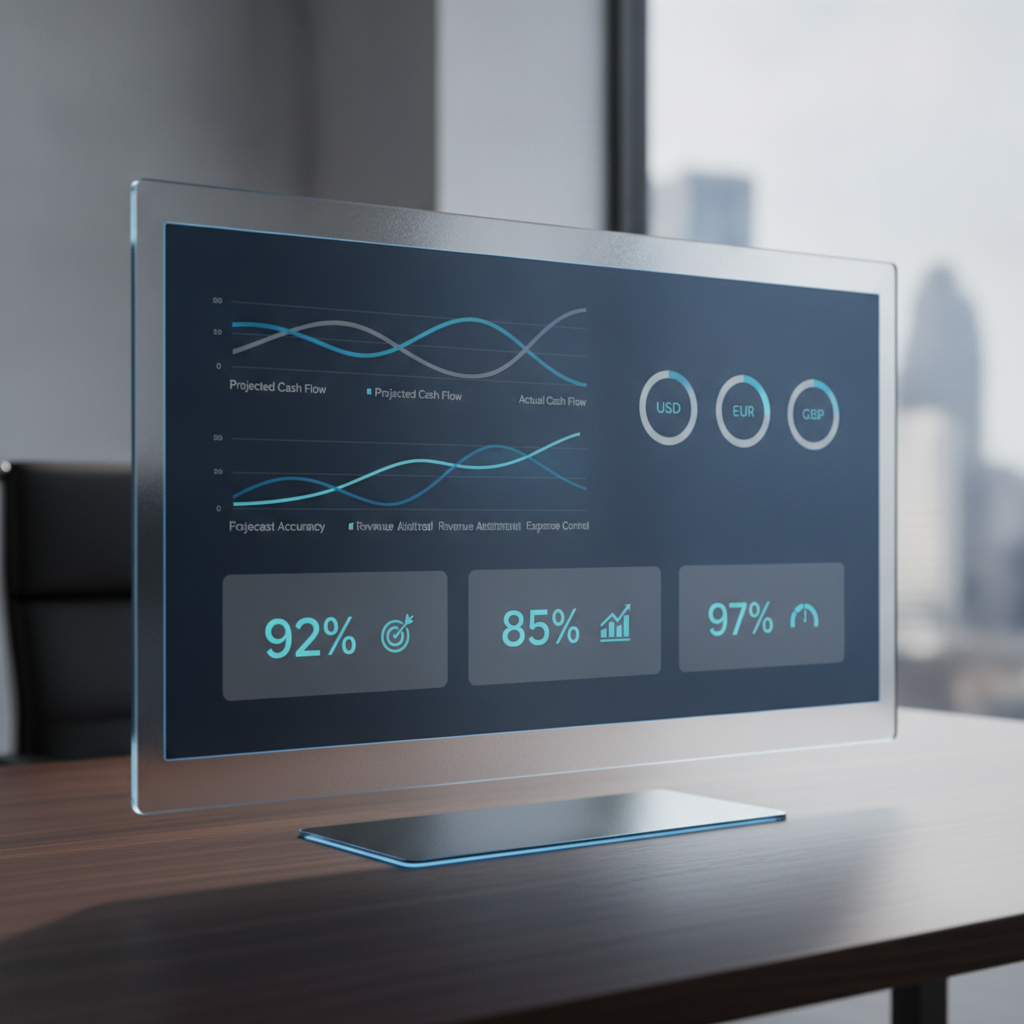
The practical value of Dynamics 365 Finance Insights cash flow forecasting becomes clear when you deploy it specifically for what it does well: automating the baseline forecast that captures recurring cash patterns. Instead of a finance controller manually updating a spreadsheet with assumptions about seasonal collections patterns, payroll cycles, and vendor payment terms, the AI model learns these patterns and generates updated projections whenever new transactional data arrives. The baseline becomes self-updating, and the finance team shifts focus from mechanical forecasting to exception-based analysis.
Dynamics 365 Finance Insights also surfaces forecast accuracy metrics, showing finance teams how well the model predicted actual cash outcomes over trailing periods. This feedback loop is valuable, because it reveals whether patterns the model identified have remained stable or have shifted. If the model historically predicted collections within plus-or-minus 3 percent but suddenly starts missing by 8 percent, that is a signal that underlying customer payment behavior has changed and warrants investigation.
What-if scenario analysis is another capability that multiplies the value of AI-driven forecasting. Once the baseline forecast is in place, finance teams can create alternate scenarios representing different business conditions (optimistic growth, pessimistic demand, recession response) and overlay them on top of the baseline. This capability let you rapidly explore how cash positions respond to different strategic choices without rebuilding the entire forecast from scratch.
The Three Scenarios Where AI Forecasts Lead Finance Teams Astray
Reliance on AI-only cash forecasting becomes problematic in specific, predictable scenarios that every finance team encounters:
Structural changes to cash flow drivers. When your business model shifts, historical patterns become unreliable. If you transition from on-premises software licensing (lump-sum collections upfront) to a subscription SaaS model (monthly recurring revenue spread over years), the AI model trained on your old licensing pattern will dramatically overforecast near-term collections. The model needs retraining on new data, but that can take months. In the interim, finance teams need human judgment to reframe the forecast against the new revenue model, or they will drastically overestimate liquidity.
One-time events with material cash impact. A large customer prepayment, a debt refinancing, an asset sale, a business combination, or an unexpected insurance recovery all create cash movements the model has no historical precedent for. These events typically require advance knowledge and business context to forecast. If a CFO knows a customer prepayment of $20 million is coming in Q2 but the AI model knows nothing about it, the combined view (baseline forecast plus known one-timers) is far more useful than either alone.
Seasonal and cyclical patterns that have shifted over time. AI models can capture long-term seasonal patterns, but if the magnitude or timing of seasonality has changed, the model can lag in detecting and adapting to that shift. A company that has historically seen strong Q4 collections might have shifted to a more consistent quarterly pattern due to customer base changes. The model will still expect a Q4 spike based on historical data, whereas a finance controller watching year-over-year trends will notice the pattern has evolved and adjust accordingly.
In all three scenarios, the disconnect is the same: the AI model is solving for accuracy on historical patterns, while finance teams are solving for visibility into forward cash positions shaped by strategy, one-off events, and changing market conditions. Neither is wrong. They are just operating on different time horizons and information sets.

Building Governance Around AI Forecasts
The path to effective AI-driven cash flow forecasting in Dynamics 365 Finance is not to replace human judgment but to institutionalize how the two interact. This requires a lightweight governance framework that clarifies when the AI forecast is trusted as-is, when it needs overlay, and who is responsible for validating the forecast before it drives working capital decisions.
Start by establishing a forecast validation workflow that requires the finance controller or working capital manager to review and sign off on cash forecasts before they are used for liquidity planning or short-term borrowing decisions. This review should be structured and quick, not bureaucratic. The reviewer should check three things: Does the forecast direction match current business trends? Are known one-time cash events accounted for? Are there any recent structural changes to the business (pricing model shift, customer mix evolution, payment term changes) that the AI model would not yet have learned?
If the answers are yes, the AI forecast can proceed unchanged. If the answers are no, the review process should support rapid overlay of business context. Dynamics 365 Finance Insights allows finance teams to create scenario variants and what-if analyses that can quickly model known events or strategic changes on top of the baseline forecast. This is not rebuilding a forecast in Excel; it is using the system to layer business judgment on top of the AI baseline.
Over time, as the AI model learns from corrected forecasts and forecast validation patterns, the lag between model behavior and business reality should narrow. A finance team might discover that 80 percent of forecasts pass validation without change, while 20 percent require overlay of known one-timers or cyclical pattern adjustments. Documenting those patterns helps you identify where the model needs retraining or where business context should be automatically fed back into the forecasting process.
The Compound Effect of Forecast Discipline
Finance leaders often underestimate the leverage of accurate cash flow forecasting on decision-making velocity. If a CFO has high-confidence visibility into 24-month cash position, working capital decisions that would otherwise require contingency buffers can be optimized. Seasonal borrowing decisions become more predictable. Investment in accounts receivable improvement initiatives can be prioritized based on forecast impact. Strategic decisions about capital allocation, debt paydown, and dividend policies can be made with clearer information about future liquidity.
Conversely, a forecast that the CFO does not trust becomes either a shelf-ware artifact that no one uses, or worse, a forecast that is blindly followed and leads to strategic surprises. Many companies keep a spreadsheet forecast alongside their ERP forecast precisely because they do not trust the system forecast.
The investment in building governance discipline around AI-driven forecasting is usually small relative to its impact. A monthly 30-minute forecast review and validation workflow, combined with clear ownership for feeding business context back into the system, is enough to shift AI forecasts from mathematical curiosities to operational planning tools.
Making the Shift from Manual to Augmented Forecasting
The transition from Excel-based forecasting to AI-driven forecasting in Dynamics 365 Finance requires more than just enabling the feature. It requires reframing how finance teams think about forecasting: not as a document to be produced, but as an ongoing process that blends machine intelligence with human business judgment. The AI model generates the baseline, eliminating the mechanical work. Finance controllers validate and contextualize it, adding business judgment. Together, the two create a forecast that is both statistically grounded and strategically sound.
Organizations that make this transition successfully are usually those that treat the AI forecast as the starting point for a conversation, not the destination. They ask: Where does the forecast seem right, and where does business knowledge suggest it should be adjusted? What events on the horizon will reshape cash patterns that the model does not yet know about? How can we feed that business context back into the system to continuously improve forecast quality?
These questions shift forecasting from a cost center (people spending time in spreadsheets) to a strategic process (finance contributing to working capital optimization and capital allocation decisions). The shift is not automatic. It requires discipline, clear ownership, and a commitment to treating forecasts as living documents that evolve as business conditions change. But the payoff for finance organizations disciplined enough to make the shift is significant: better visibility, faster decision-making, and working capital strategies grounded in both mathematical rigor and business reality.
At Routeget Technologies, we help organizations build governance discipline around financial analytics and forecasting, ensuring that AI-driven insights inform rather than replace strategic decision-making. If you are implementing cash flow forecasting in Dynamics 365 Finance and want to ensure adoption and accuracy, our consulting team can help design the validation workflows and governance structure that turn machine forecasts into actionable business intelligence.
#DynamicsFinance #CashFlowForecasting #FinanceInsights #WorkingCapitalOptimization #CFOStrategy #FinancialPlanning #DynamicsF&O
No comment yet, add your voice below!