Scaling Customer Support Operations Without Hiring: Building Autonomous AI Agents in Copilot Studio for Enterprise Support Teams

Your customer support department is receiving 30 percent more inbound requests than it did two years ago. The inbound volume keeps climbing. Hiring more agents is becoming difficult in a tightening labor market, onboarding takes months, and seasonal fluctuations make headcount planning unpredictable. At the same time, your CFO is asking every department to improve efficiency without increasing budgets. The math is straightforward: you need your support team to handle higher volumes without proportional headcount growth, or you’ll fall behind on response times and customer satisfaction.

Autonomous AI agents built in Copilot Studio offer a direct answer to this pressure. Rather than hiring additional people, a well-designed agent can field common requests, resolve routine issues, and escalate complex problems to human specialists, allowing your team to focus on cases that truly require human judgment and empathy. The agents run 24/7 without breaks or overtime pay. A single agent can process dozens of concurrent interactions across channels. For operations leaders managing support costs, this changes the unit economics of customer support fundamentally.

The Cost Structure Problem in Traditional Support Operations

A typical enterprise support team operates on per-agent costs that include salary, benefits, training, management overhead, and tools. If the average fully-loaded cost of a support agent is between 75,000 and 100,000 dollars per year, and each agent typically handles between 6 and 12 customer interactions per hour, the per-interaction cost ranges from 5 to 12 dollars when you factor in idle time, training, and administrative overhead. For a support organization handling 50,000 interactions per month, this translates to 250,000 to 600,000 dollars in direct labor cost monthly.

The challenge compounds during seasonal peaks. Holiday shopping, product launches, or service incidents cause request volume to spike 2 to 3 times normal levels. Hiring temporary contractors is expensive and brings quality risk. Overtime pushes per-hour costs higher. Existing agents burn out, and retention suffers.

Copilot Studio agents disrupt this cost structure by removing the variable labor cost entirely from routine interactions. An agent that resolves 40 percent of incoming requests eliminates the need for approximately 40 percent of human headcount dedicated to handling volume. At a support organization of 50 agents handling routine work, eliminating 40 percent of routine-request volume means you avoid hiring 20 additional agents to keep up with growth, or you redeploy 20 existing people to higher-value work.

Building Agents That Resolve Issues, Not Just Deflect

The critical difference between an effective agent and a frustrating one lies in scope and handoff clarity. A poorly designed agent that simply routes every non-trivial request back to a human adds friction to the customer experience without reducing team workload. An effective agent does meaningful triage and resolution.

Copilot Studio agents connected to your Dynamics 365 Customer Service, Finance, or Business Central data can accomplish substantive work. An agent can query a customer’s account history, check order status, verify warranty information, and approve common request types such as refunds below a threshold, password resets, or schedule changes without human involvement. When the agent determines a request falls outside its authority, it escalates with context preserved, so the human agent starts with full information rather than asking the customer to repeat themselves.

The agent’s knowledge base should combine your product documentation with your internal decision rules. Documentation alone is insufficient because customers often ask questions that require your company’s specific policies. “Can I return this after 30 days?” needs an answer that reflects your company’s return window, not just a generic explanation of what returns are. Agents trained on both product knowledge and company policy can resolve requests correctly on the first interaction.

Handoff matters more than most teams expect. When an agent escalates to a human, the transition should feel seamless to the customer. The agent should summarize what it has learned, highlight the reason for escalation, and if possible, pre-fill a support ticket with context. This eliminates the frustration of being transferred and having to re-explain the problem. From the human support agent’s perspective, they receive tickets with full context, reducing their own resolution time and allowing them to focus on problem-solving rather than information gathering.

Channel Flexibility and Availability

One reason support costs are high is that you need people across multiple channels. Traditional support organizations staff channels separately: phone support, email, chat, social media. A 24/7 phone line requires multiple shifts. Email requires dedicated reviewers. Chat and social media need immediate response to feel current. The cost of maintaining presence across all channels is multiplicative.

Copilot Studio agents operate across channels simultaneously. A single agent can handle chat, email, social media direct messages, and Teams messages from the same knowledge base and decision logic. The agent doesn’t get tired, doesn’t take breaks, and doesn’t require shift planning. For an operations leader, this means you can commit to faster response times across all channels without proportional staffing increases.

Seasonal spikes become manageable. During peak season, you don’t hire temporary staff for specific channels; you increase your agent capacity uniformly. Peak-period labor costs become flat rather than variable, and you avoid the quality risks that come with inexperienced temporary workers.

Implementation Realities and Maintenance Burden

Building an autonomous agent sounds straightforward in theory but requires attention to scope, training data quality, and escalation rules in practice. A poorly configured agent that attempts to handle issues beyond its competence, or that escalates every edge case, creates more work for human teams than it eliminates. The agent must be tuned: training data must be accurate and comprehensive, intent recognition must be sharp, and fallback behavior when the agent is uncertain must be graceful.

The initial build requires time investment from your product, support, and technical teams. Documenting policies, identifying common request patterns, and defining escalation triggers takes weeks, not days. The agent must be tested extensively before launch, because a public-facing agent that gives incorrect answers damages customer relationships quickly.

After launch, maintenance is ongoing. Product features change, policies evolve, customer preferences shift. The agent’s knowledge base must stay current or it provides stale information. Monitoring agent performance is essential: tracking resolution rates, customer satisfaction scores for agent-resolved interactions, and escalation patterns tells you whether the agent is actually reducing workload or just generating more tickets.

Teams that succeed with agents dedicate someone to ongoing optimization, treating the agent as a product that requires maintenance rather than a one-time implementation project.

Business Case and Timeline

For a 50-agent support organization handling 50,000 interactions monthly, implementing an autonomous agent that resolves 30 to 40 percent of incoming requests reduces the need for 15 to 20 additional agents to keep up with growth. At a fully-loaded cost of 85,000 dollars per agent annually, that’s a 1.275 to 1.7 million dollar savings on an annual basis. Copilot Studio implementation, training, and integration with Dynamics 365 typically costs between 50,000 and 150,000 dollars for a well-scoped project, plus modest ongoing maintenance.

The payback period is typically 3 to 6 months. The agent pays for itself almost immediately, and the ongoing savings scale as your support volume grows.

Pilot projects should be modest in scope. Start with one support queue handling common, high-volume requests where success is easy to measure: password resets, order status checks, refund eligibility determinations. Define clear metrics before launch: resolution rate, time to resolution, customer satisfaction score for agent-resolved interactions, and human escalation rate. Run the pilot for 4 to 6 weeks to gather meaningful data, then decide whether to expand.

Organizations that start narrow, measure carefully, and optimize based on data typically expand to multiple agent implementations quickly. The business case is so strong that support teams invest in additional agents once the first one demonstrates value.

The Future of Support Operations

As customer expectations for self-service and immediate availability continue to rise, autonomous agents will become standard infrastructure rather than a competitive advantage. Support organizations that don’t implement agents will find themselves at a cost disadvantage within the next 2 to 3 years. Early adopters who build agent capabilities now will establish practices, training, and experience that become difficult for competitors to match quickly.

For operations leaders evaluating where to invest in efficiency, Copilot Studio agents are one of the highest-leverage investments available right now. The cost reduction is immediate, the implementation timeline is measured in weeks rather than months, and the operational benefits compound as your support volume grows.

Routeget Technologies has implemented autonomous support agents for enterprise customers across multiple industries, from financial services to manufacturing. We can help you scope a pilot project, integrate your Dynamics 365 environment with Copilot Studio, and build agents tuned to your specific policies and customer base. The investment is modest, the timeline is short, and the payback is measurable and fast.


#CopilotStudioAgents #CustomerSupportAutomation #AutonomousAI #SupportOpsEfficiency #Dynamics365Integration #EnterpriseCustomerService

Building Autonomous Agents with Copilot Studio: Moving Beyond Chatbots

# Building Autonomous Agents with Copilot Studio: Moving Beyond Chatbots

Most organizations implementing Copilot Studio treat it as an intelligent chatbot that responds to user queries. That’s a missed opportunity. The platform’s real power lies in building autonomous agents that can make decisions, trigger downstream processes, and handle multi-step workflows without human intervention at each stage. Finance teams processing invoice exceptions, HR departments handling onboarding, and supply chain teams managing vendor communications all stand to benefit.

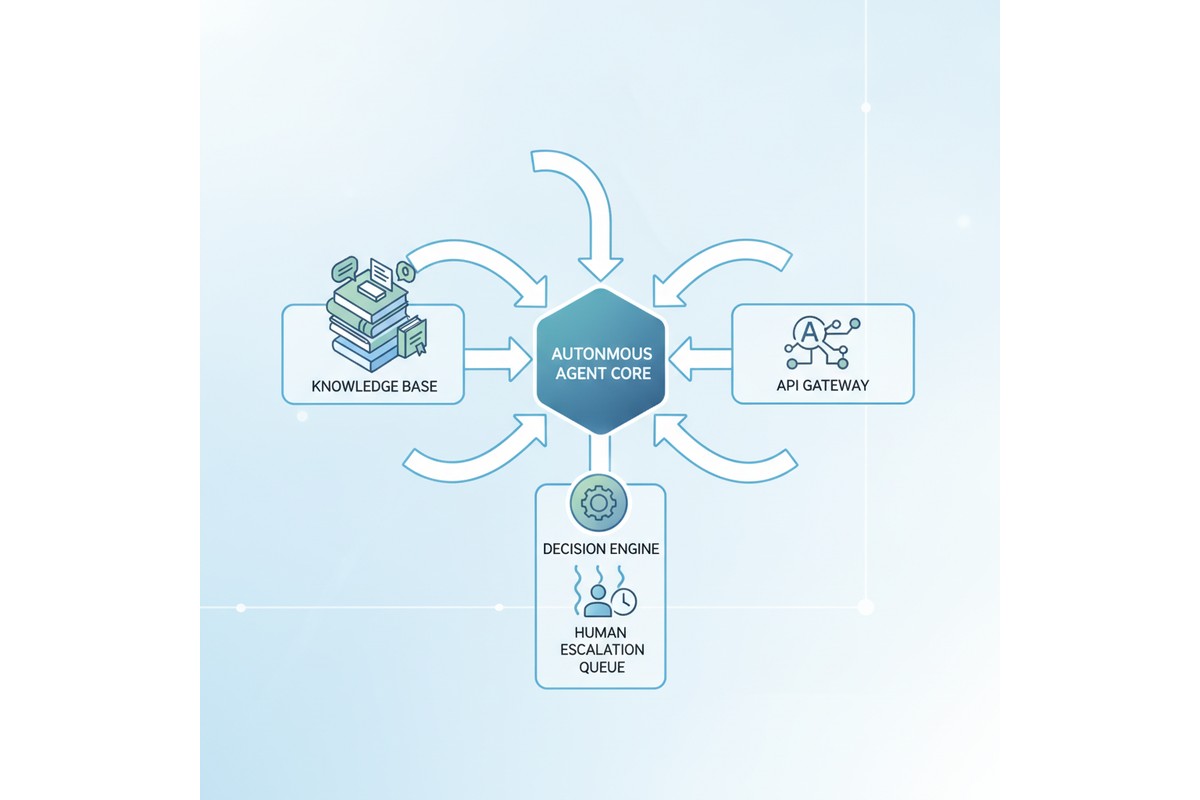
Copilot Studio autonomous agent system architecture

The gap between a chatbot and an autonomous agent comes down to three capabilities: the ability to invoke external systems without manual triggers, the capacity to make contextual decisions based on structured data, and the skill to maintain state across actions without restarting. Most Copilot Studio implementations lack these, which means their agents remain reactive and conversation-driven rather than autonomous and process-driven.

Building such an agent requires careful attention to custom actions, knowledge base integration, prompt engineering, and error handling. It’s not enough to wire up an API connection. You need to architect the agent so it knows when to act independently, how to handle failures gracefully, and when to escalate decisions to human reviewers.

Autonomous Agents vs. Interactive Chatbots

An interactive chatbot waits for user input at every step. The user submits a question, the chatbot responds, and the conversation ends until the next message arrives. Autonomous agents complete tasks without requiring user input at each decision point.

Consider a claims-processing agent. An interactive version might ask, “Does this claim qualify for expedited review?” and wait. An autonomous agent evaluates the claim against configured rules, makes the decision independently, updates the backend system, and notifies stakeholders automatically. The user’s role shifts from guiding each step to reviewing high-risk exceptions.

This design shift affects multiple aspects. First, the agent must understand when to act without prompts, requiring condition evaluation and decision trees beyond natural language understanding. Second, the agent must have authority to modify downstream data, introducing governance questions about which decisions need audit trails, human review, or policy-based automation.

Third, autonomous agents must recover from failure states gracefully. If an API call fails, an interactive chatbot tells the user it didn’t work. An autonomous agent must retry, escalate, or follow a fallback path based on business logic. Building robust error handling into the agent’s design from day one is essential.

Custom Actions and API Integration

Copilot Studio’s custom actions allow you to connect to external APIs and invoke them as part of the agent’s workflow. This is where many implementations falter. Teams configure basic actions without thinking through how the agent should behave when an API call fails, how long it should wait, or whether it should retry.

For a typical autonomous agent, you’ll define custom actions for the key external systems your agent needs to access. In a finance context, this might mean actions that query an ERP system to check if a purchase order exists, retrieve the purchasing history for a vendor, or post a transaction to the general ledger. In an HR context, you might define actions to look up employee records, check manager approval status, or send notifications through Teams or email.

Each action should include error handling at the definition level. Define which HTTP status codes are retryable (typically 502, 503, 504 and timeout errors), which represent permanent failures (400, 401, 403), and which might represent missing data (404). Configure exponential backoff for retries to avoid overwhelming the downstream API.

The other critical design choice is authentication. Copilot Studio supports connection references, which allow you to authenticate to external APIs securely. For a finance agent, you might use a service account that has specific permissions (read-only access to check PO status, but write access only to specific GL accounts). Never give your agent more permissions than it needs. If an agent is compromised, narrow permissions limit the damage.

Knowledge Base Integration

Most Copilot Studio agents include at least one knowledge base: a collection of documents or FAQs that the agent can reference when answering questions. For autonomous agents, knowledge bases serve a different purpose. Rather than storing answers to user questions, you use them to store decision logic, business rules, and process documentation that the agent uses to make autonomous decisions.

Consider a vendor onboarding agent. Instead of storing a knowledge base full of “How do I become a vendor?” FAQs, you store the actual business rules: vendors in certain geographic regions require additional tax documentation, vendors spending over a certain threshold need credit checks, and vendors in specific industries need compliance certifications. The agent retrieves these rules from the knowledge base, evaluates them against the vendor’s profile, and determines which documents need to be collected before onboarding can proceed.

This approach works because Copilot Studio’s retrieval-augmented generation (RAG) allows the agent to fetch relevant information from the knowledge base and incorporate it into its reasoning. The agent doesn’t just repeat back what’s in the knowledge base; it uses the information to make decisions.

For this to work reliably, your knowledge base content needs to be structured and current. Avoid storing conflicting information. If rule A says “credit checks are required for vendors over $100K” but another document says “credit checks are needed for vendors over $50K,” the agent’s behavior becomes unpredictable. Centralize your business rules in a single source of truth, and refresh the knowledge base whenever rules change.

Prompt Engineering for Autonomous Decision-Making

The system prompt enables autonomous action. A poorly written prompt produces an agent that refuses decisions or decides carelessly. A strong system prompt includes four elements: clear boundaries on what decisions it can make versus escalate, step-by-step decision logic (“Check vendor history using the vendor-lookup action. If they have 50 successful transactions in the past 12 months and average payment time under 30 days, they qualify for expedited payment”), guardrails for when to escalate (“If you cannot retrieve the vendor record after two retries, escalate with a detailed explanation”), and instructions for maintaining context (“Remember the vendor ID throughout. Do not make redundant lookup calls”). Specificity separates reliable agents from unreliable ones.

Error Handling and Escalation Workflows

Every autonomous agent will encounter situations where it can’t proceed. An API call fails. Required data is missing. A decision requires human judgment because it involves an exception to the normal rules. How the agent handles these situations determines whether it’s actually useful.

Design your escalation workflow first. Identify three or four common failure scenarios for your agent. For a claims processor, these might be: missing medical documentation, conflicting diagnoses from different providers, and claims that exceed specific dollar thresholds. For each scenario, define who reviews it, what information they need to see, and how they communicate their decision back to the agent (if it needs to resume).

In Copilot Studio, escalations typically flow through Power Automate. When your agent encounters a situation that requires human review, it creates a ticket or sends a notification through Teams, Power Automate, or a ticketing system. That ticket should include all the context the reviewer needs: the data the agent gathered, the decision it tried to make, and why it couldn’t proceed.

When the human reviewer makes a decision, it needs to flow back to the agent. This might happen through manual input in Teams, through an approval flow in Power Automate, or through a custom action that queries decisions from a database. The agent needs to know what the reviewer decided and continue processing if appropriate.

Test your error handling paths before going live. Don’t assume the happy path works and hope the error handling magically works when things go wrong. Deliberately trigger failures: kill an API connection, send bad data, create scenarios where required fields are missing. Observe how your agent behaves and refine the escalation logic.

Testing Autonomous Agents

Testing an autonomous agent is more complex than testing a chatbot because behavior depends on data state, API responses, and decision logic. Test at three levels: individual actions in isolation using Copilot Studio’s built-in testing, decision paths using test data with known outcomes, and escalation and error handling by simulating API failures and missing data. For each scenario, document expected behavior and verify the agent performs as designed.

Governance and Monitoring

Autonomous agents that make decisions without human review carry risk. Build governance into your design by logging every decision with the context that informed it. Set up monitoring dashboards that track autonomous decisions, escalations, errors, and human overrides. If humans override agent decisions more than 20 percent of the time, the agent’s logic needs refinement. Schedule periodic audits to verify correctness and identify patterns in mistakes, then update the system prompt or decision logic to correct them.

Conclusion

Building a true autonomous agent in Copilot Studio requires more up-front design work than building a chatbot, but the payoff is significant. Autonomous agents reduce manual work, ensure consistent decision-making, and allow organizations to scale processes without proportional increases in headcount. The key is treating autonomy as a design requirement from day one: architect your custom actions, knowledge base, prompts, and error handling specifically to support autonomous decisions, and build governance and monitoring to ensure those decisions stay accurate over time.

—

**About Routeget Technologies:** Routeget specializes in designing and implementing autonomous agents across the Microsoft cloud platform, helping organizations move beyond chatbots to truly autonomous processes. Our team brings hands-on experience building agents for finance operations, supply chain, HR, and customer service use cases, with a focus on robust error handling, governance, and measurable business outcomes.

#CopilotStudioAgents #AutonomousAgents #PowerPlatform #AIDecisionMaking #ProcessAutomation #Microsoft365AI #AgentDesign

#CopilotStudioAgents #AutonomousAgents #PowerPlatform #AIDecisionMaking #ProcessAutomation #Microsoft365AI #AgentDesign