
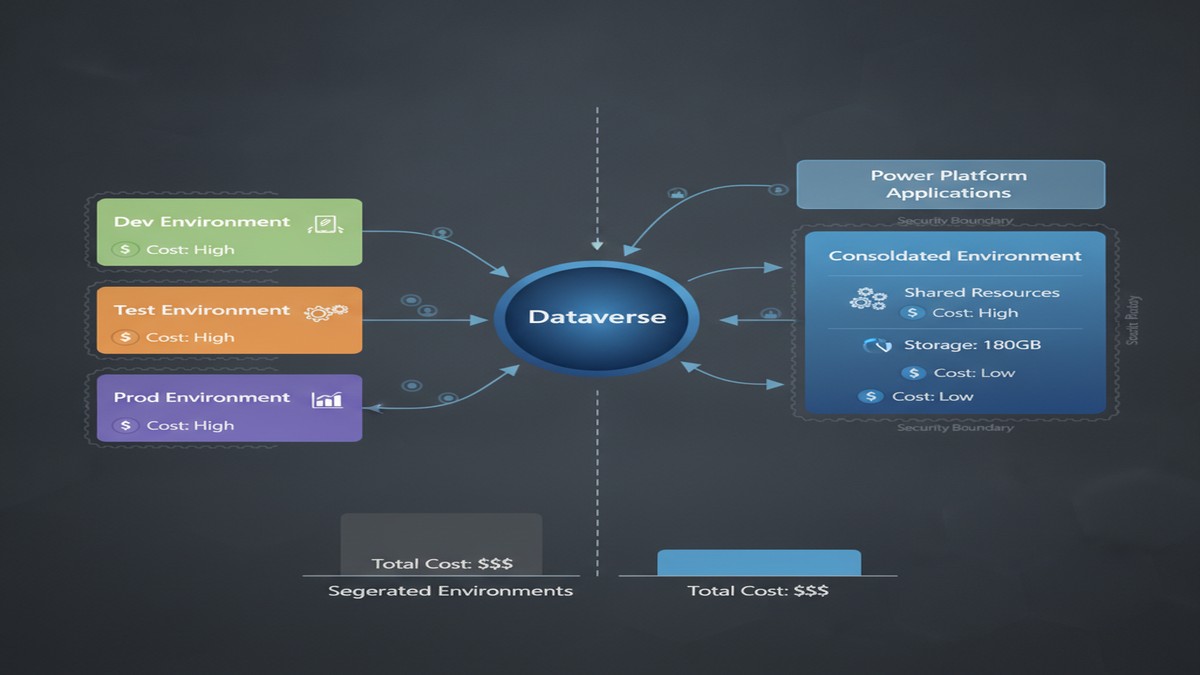
When you first deploy Dataverse, the storage bill arrives as a small surprise. When you deploy your tenth instance, it arrives as a budget problem. This escalation is not accidental. It reflects a choice you likely did not consciously make: the decision to separate Dataverse environments.
Most organizations start with a single development environment, then add a staging environment for UAT, then a production environment for the main line of business. Six months later, there’s a second production environment for a parallel business unit. A year in, IT has provisioned separate Dataverse instances for finance, operations, customer service, and a pilot project that “just needed a sandbox space.” Each instance accrues storage costs, backup overhead, governance complexity, and security review burden. The organization paid for all of it. Few asked whether they needed to.
The question “Should we consolidate or segregate?” never came up because it felt obvious: production should be separate from development. But that clarity evaporates once you have multiple business units, overlapping data needs, and genuine compliance constraints. Consolidation looks cost-efficient until you calculate the management burden. Segregation looks secure until you realize your core customer data lives in four places and nobody knows which is authoritative.
The answer is neither pure consolidation nor pure segregation. It is strategy.
Understanding the Cost and Governance Tensions
Dataverse pricing ties directly to storage consumption and the number of instances you maintain. A 10 GB storage license costs roughly 100 USD per year. An organization with ten segregated Dataverse environments, even with light usage, pays backup, redundancy, and management overhead across each one. The cloud infrastructure beneath Dataverse (Azure) charges for compute, storage durability, and replication regardless of how full your instance is. A mostly empty Dataverse environment costs nearly as much as a full one.
Segregation creates what appears to be security clarity: production data stays in production, development in development, finance data in finance. This isolation has genuine value. A misconfigured Power Automate flow in a development sandbox cannot accidentally update live customer records. A security breach affecting one environment need not compromise all of them. But segregation imposes a hidden cost: data synchronization, duplicate records, inconsistent customer views, and reconciliation overhead. If customer records live in both a finance Dataverse and an operations Dataverse, which is the source of truth when they conflict? Who owns the resolution process?
Consolidation eliminates that duplication. A single Dataverse instance holding all enterprise data means one source of truth for customer records, one master file for products, one system of record for financial transactions. You skip the synchronization overhead, the reconciliation disputes, and the headache of knowing which Dataverse has the current information. The cost per record drops. But the security model becomes more complex. Consolidation means granting broader data access to more users and applications, requiring tighter role-based access control, field-level security rules, and auditing to prevent accidental or malicious data leakage. A single misconfigured permission model puts more data at risk than a segregated approach would.

When Segregation Makes Economic Sense
Segregation is the right strategy when regulatory compliance or data residency mandates isolation. A healthcare organization subject to HIPAA cannot store patient records alongside non-protected business data in the same system without additional access controls that approach the complexity of separate systems anyway. A financial services firm with customer data subject to SOX or PCI compliance, or an organization operating in multiple countries with GDPR or localization requirements, often finds segregation is mandated by policy rather than chosen for efficiency.
Segregation also makes sense when a subsidiary or business unit operates as a distinct legal entity with its own data ownership and governance. If your organization acquired a company and that company operates with its own finance department, separate Dataverse instances may be required during the integration phase and might remain appropriate long term to respect the subsidiary’s operational autonomy, even if they cost more.
Segregation further proves necessary when the organization lacks the governance maturity to enforce consistent security policies across shared data. If your Power Platform practice is young, permissioning discipline is inconsistent, and no one has ownership over a unified data governance framework, adding data to a consolidated Dataverse risks creating visibility into sensitive information that should remain restricted. In that case, segregation by business unit or application buys time for your governance practice to mature.
When Consolidation Reduces Total Cost of Ownership
Consolidation is strategically sound when you have multiple business units sharing core data, such as customers, products, and suppliers. The finance department’s customer master should be the same record your sales team references. The supply chain’s product master should be the source of truth for the pricing your finance team uses in invoicing. Consolidation eliminates the cost and risk of maintaining parallel records and reconciling discrepancies when they diverge.
Consolidation also makes sense when your organization has established governance discipline and a clear data stewardship model. If you have defined data ownership (finance owns the general ledger, supply chain owns inventory, sales owns opportunities), have role-based security groups mapped to those functional areas, and have audit mechanisms in place to catch permission violations, a consolidated Dataverse becomes a platform strength rather than a security risk. Your cost per record drops, your data consistency improves, and you simplify the user experience by giving people access to the unified information they need rather than requiring them to navigate to separate systems.
Consolidation further makes sense for organizations with mature ALM (application lifecycle management) practices. Consolidated Dataverse allows you to deploy solutions and flows to shared data layers without the release complexity of managing separate instances. Your development, staging, and production environments can all point to logically separated Dataverse spaces within a single instance, reducing provisioning overhead and backup complexity.
Hybrid Models and Environmental Separation Within a Single Instance
Many organizations land on a hybrid approach: one or two consolidated production Dataverse instances for the main business, with a separate development/test environment reserved for experimental solutions and non-production use.
This model recognizes that some segregation is necessary (development must be isolated from production), while consolidation of core business logic and shared data eliminates duplication and cost. Within a single Dataverse production instance, you use solution layers and environment variables to manage configuration differences for different business units or applications, avoiding the need for separate instances.
The Operational Complexity Multiplier
Many organizations underestimate the operational cost of managing multiple Dataverse instances. Each instance requires backup policies, disaster recovery testing, access control reviews, security patching coordination, and licensing reconciliation. Each instance needs monitoring for performance issues. Each introduces a potential point of data quality failure. If you have ten Dataverse environments with inconsistent master data definitions, ten different backup schedules, and ten separate access reviews, you have essentially maintained ten times the governance surface area compared to one consolidated instance.
Recommendations for Decision-Makers
Before you provision another Dataverse instance, ask whether the request stems from genuine compliance isolation or from organizational convenience. If it is convenience, consider whether investing in your governance model (clearer role definitions, field-level security policies, auditing) would be more cost-effective than the ongoing operational overhead of maintaining a separate instance.
If you already have multiple instances, analyze the actual data sharing patterns. Do core business entities (customers, products, suppliers) need to be synchronized across instances? If so, you are paying the cost of segregation while accepting the complexity of consolidation. A strategic consolidation project to merge those shared entities might cost less over three years than the recurring duplication and reconciliation overhead.
Document your environment strategy explicitly. Do not let instances accumulate by default. Routeget Technologies works with organizations to audit their existing Dataverse footprint, quantify the cost-benefit of consolidation versus continued segregation, and design transition plans that respect compliance constraints while reducing total cost of ownership. The difference between a well-planned environment architecture and an ad-hoc collection of instances often runs to hundreds of thousands of dollars annually for larger deployments.
Hashtags: #DataverseArchitecture #EnvironmentStrategy #PowerPlatformGovernance #EnterpriseDataManagement #DataverseCostOptimization #CloudGovernance #MicrosoftDataverse
No comment yet, add your voice below!