
Power Automate Error Handling: Building Resilient Cloud Flows That Don’t Fail Silently

Power Automate Error Handling Architecture Diagram

You launch a critical approval workflow into production, and for two months it runs without obvious issue. Then Finance calls: a vendor invoice sits stuck in limbo, and the escalation that should have fired never arrived. You check the flow history. The run shows “Succeeded,” but the approval task was never created, and no notification reached anyone. Silent failure, the kind that eats hours of investigation and delays payment cycles.

This scenario repeats across organizations deploying Power Automate at scale. The default error handling behavior in cloud flows is permissive and forgiving, designed to let flows complete even when individual actions fail. This is convenient during development but disastrous in production, where a missing HTTP response, a timing issue on an approval task creation, or an unexpected data format in a downstream system turns silent into undetected. The flow completes successfully by the application’s measure, but business logic never executes. Error handling in Power Automate is not a nice-to-have feature for robustness; it is the architectural foundation that separates production-ready automation from toy scripts.

Understanding Default Behavior and Why It Fails

By default, Power Automate treats a failed action like a skip. If an “Create an approval” action times out or receives an unexpected response, the flow continues to the next step. Conditional actions branch on the previous action’s status, but most flows don’t include that branching. An approval might never materialize, yet the flow proceeds as if it succeeded, sending payment confirmations or triggering downstream systems based on assumptions about work that never completed. Notification actions often sit at the end of a flow, so if an error occurs mid-stream and the flow halts before reaching the notification step, no one knows failure occurred. The inbox has no warning. The flow history shows green. Days pass before someone manually discovers the orphaned record.

This happens because Power Automate distinguishes between a failed action and a failed flow. A single failed action can leave the flow in a half-completed state that still reports success. Production systems need explicit acknowledgment of failure, not a default assumption of continuation. Scope actions, try-catch patterns, and notification strategies are the techniques that transform Power Automate from a convenient desktop automation tool into a reliable production system.

Scope Actions and Error Handling Tiers

The core building block for error handling in Power Automate is the Scope action, which wraps a logical group of steps and exposes four possible outcomes: Succeeded, Failed, Skipped, and TimedOut. A Scope action acts like a transaction container. If any step inside fails, the Scope itself fails, and you can then use the Configure run after property to branch on that failure state. Configuring a Scope so that downstream actions only run if the Scope succeeded is the first layer of error handling.

For critical workflows, organize Scopes into layers. A “happy path” Scope contains the main logic (create approval, send notification, update records). A “validation” Scope runs first and checks input data before attempting the main workflow. An “error handling” Scope runs only if the happy path fails, containing steps to log the error, notify a human, and roll back any partial state. This layering makes the flow’s intent explicit: if the happy path fails for any reason, the error layer kicks in. If the error layer itself fails (for example, the notification system is temporarily down), that failure is also visible and can trigger escalation.

Implementing Try-Catch Patterns

A try-catch pattern in Power Automate maps to a Scope (try) followed by a Configure run after rule (catch). After a critical Scope completes, even if it failed, configure the next action to run only if the Scope failed. Inside this catch block, add steps to capture what went wrong (log the error message and flow context), notify the appropriate person or system, and decide whether to retry or abandon. For approval workflows, a catch block might check if the approval was actually created (by querying Dataverse) before sending a notification. If the approval does not exist, log the specific error and notify a supervisor that manual intervention is needed.

The catch block should not attempt to continue the main business logic. Trying to recover by re-running the failed step or guessing at a default value introduces risk. Instead, catch blocks should focus on observation (logging), communication (notification), and escalation (routing to a person or alert system). This keeps the error path simple and auditable. When a catch block executes, someone should know about it, and the flow should stop rather than creating inconsistent downstream state.

Technical Team Reviewing Power Automate Error Handling Strategy

Handling Timeouts and Asynchronous Gaps

Timeouts are a class of failure distinct from logic errors. An action that calls an external API might exceed Power Automate’s timeout thresholds (2 minutes for cloud flows, 10 minutes for desktop flows) through no fault of the flow’s logic. A synchronous HTTP action to a slow third-party API will reliably timeout in production if that API experiences latency. Asynchronous patterns are the solution: instead of waiting synchronously, send an asynchronous request and poll for the result, with explicit limits on retries and elapsed time. A Scope action wrapping an HTTP POST followed by a repeat-until loop that polls for completion gives you control over timeout behavior.

Approval actions introduce similar asynchronous complexity. When you create an approval task, the action returns immediately, but the approval itself is time-consuming. If you try to check the approval’s response in the next step and the approver has not yet responded, your flow will either wait forever or timeout. Structure approval flows so that the approval creation is one Scope, any actions that depend on the approval response are in a separate step or flow triggered asynchronously (via a Power Automate Connector trigger or notification), and the main flow completes after the approval is created. This prevents the flow from blocking indefinitely and makes it clear which parts of the workflow are synchronous and which are asynchronous.

Notification and Escalation Strategies

An error that no one knows about is still an error. Every production flow needs explicit error notification. For non-critical flows, a daily digest of failed runs might suffice, sent to a service account inbox where admins can triage them. For critical workflows, errors should trigger immediate notification to an on-call engineer or supervisor through a dedicated notification system (Teams, Slack, email, or an alert system). Configure the notification to include the flow name, the step that failed, the error message, the affected record ID (invoice number, order ID), and a direct link to that flow run in the Power Automate admin portal so the engineer can investigate immediately.

For approval workflows, escalation is the second notification layer. If an approval sits unapproved for 24 hours, send a reminder to the approver. If it sits for 48 hours, escalate to the approver’s manager or a shared mailbox. Implement this using scheduled cloud flows that query the approval status in Dataverse and send conditional notifications based on elapsed time. This prevents approvals from silently stalling because someone’s mailbox was full or the approval notification was missed.

Testing Error Paths in Production

Error handling code that is never exercised is dead code. Most flow testing focuses on the happy path because that is where the visible business logic lives. But the error path is where reliability lives. Before pushing a critical flow to production, explicitly test failure scenarios: trigger an HTTP action to a nonexistent endpoint and confirm the error is caught and logged; simulate a timeout by adding a delay action and running it during off-hours; delete a required record midway through the flow to force a lookup failure; confirm that notifications fire and escalations trigger correctly. Production flows should have a pre-launch checklist that includes error path testing, not just happy path verification.

Common Architecture Mistakes

Avoid storing error handling logic in separate flows triggered by error notifications. Flows that handle errors should be part of the same versioned flow or called as child flows with explicit control flow. Separate error-handling flows that run asynchronously can miss new versions and become stale. Avoid generic retry logic that re-runs a failed action without understanding why it failed. Some errors are transient (network timeouts) and justify a retry; others are permanent (schema mismatch, missing data) and will retry indefinitely without fixing the root cause. Inspect the error message before deciding to retry. Finally, avoid logging errors to an unmonitored inbox. Logs that accumulate without review are useless. Use a proper telemetry system or a regularly tended shared mailbox so errors are actually seen and investigated.

Building Production Confidence

Error handling is not overhead added to a flow once it reaches production; it is the architecture that transforms automation from convenience to reliability. Flows that handle errors explicitly, notify on failures, and separate happy-path logic from error-path logic run predictably and build confidence with stakeholders who depend on them. The investment in error handling upfront, through scope actions, try-catch patterns, and notification strategies, is what separates a flow that your team trusts from a flow that your team monitors anxiously.


At Routeget Technologies, we architect Power Automate solutions that scale with production demands, building error handling and resilience into automation from the start rather than bolting it on after failures occur. If you’re deploying automation at enterprise scale and need guidance on error architecture or flow governance, our Power Platform specialists can help design systems your team can maintain and trust.

#PowerAutomate #ErrorHandling #CloudFlows #PowerPlatformDevelopment #ResilientAutomation #ApprovalWorkflows #PowerAutomateArchitecture

Building Approval Loops in Power Automate That Don’t Fall Apart

Enterprise approval workflow dashboard with timeout and escalation management

Approval workflows sound simple in theory. Send a request, wait for response, move forward based on outcome. But somewhere between the proof of concept and production reality, approval loops accumulate failures so quietly that six months pass before anyone notices half your approvals never closed, escalations silently vanished, and the finance team is manually reworking approvals that should have auto-completed.

The gap between what you design and what survives in production typically opens in three places: timeouts on waiting responses that get no notification when they expire, escalation logic that triggers but assumes someone is actually paying attention to a hand-passed email, and no mechanism to detect an approval that was submitted but never reached the assigned approver. Each failure is small enough to dismiss as a one-off, but they compound quickly enough that the flow looks broken even when it is technically working.

This isn’t a flaw in Power Automate itself. Approval loops are possible and reliable at scale. But they require specific configuration practices that most documentation glosses over because they fall outside the “happy path” that gets written up in tutorials. The actual production implementation involves setting constraints, monitoring for stuck states, and building reminders and escalations that stay responsive even when people are unavailable.

The Three Failure Modes in Approval Workflows

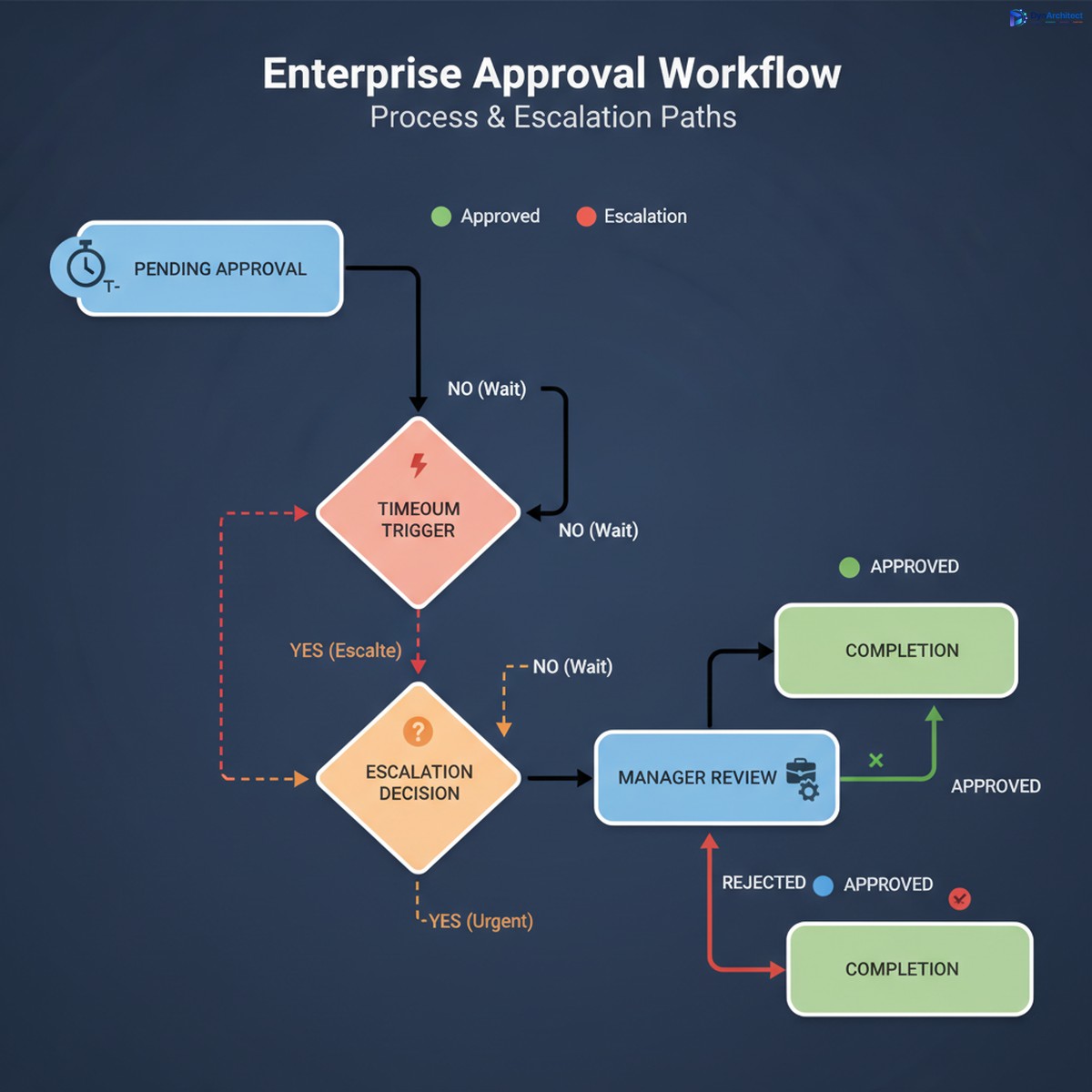
Power Automate approval workflow state transitions showing timeout and escalation paths

The first and most common failure mode is the timeout without escalation. By default, an approval waits forever for a response. In production, this means a request sits in someone’s inbox for days while they’re in meetings, on vacation, or simply overwhelmed. The approver eventually rejects or approves, but by then the original requestor has stopped watching and other parts of the process have already stalled or errored out. Better practice: set an explicit timeout on the approval action itself. Don’t wait indefinitely. Use a 48 or 72 hour window depending on your business, and when the window closes without a response, trigger an escalation workflow instead of just abandoning the request.

The second failure mode is silent escalation that nobody actually sees. When a primary approver times out, many designs hand off to a backup approver or manager using a simple email notify step. But email is not a reliable alert mechanism inside workflows. The backup approver doesn’t get a red flag in their task management system. The approval request lands in a folder with two hundred other emails. Three days later, the request is still pending, nobody knows why, and you discover by accident that the backup approver never saw it. Better practice: when escalating, create an explicit escalation record in a tracked system, assign it directly to the backup approver through Power Automate’s assignment or Outlook task creation, and log the escalation so you can report on it later.

The third failure mode is the orphaned approval that disappears from tracking. An approver response can fail for reasons outside your control: the response email is misrouted, the approval action times out before the response is processed, or the flow logic that handles the response encounters an error and doesn’t retry. In many cases, there’s no notification that the approval failed, so it simply stays pending forever. The requestor has moved on, the approver thinks they responded, and your audit log shows a request that was submitted but never resolved. Better practice: attach a completion deadline to every approval, separate from the timeout. If the approval has not resolved by that deadline, automatically resolve it with a fallback decision, and send a notification that escalation occurred.

Implementing a Production-Ready Approval Loop in Power Automate

Start with an approval request that includes a deadline. Use a scheduled cloud flow as a failsafe trigger that runs daily or every six hours and checks for approvals that have been pending longer than expected. If one is found, resolve it by creating a comment on the original record and moving the process forward with a fallback decision (typically approval, pending manager review). This sounds like it adds complexity, but it prevents the entire workflow from silently stalling.

The approval action itself should have a timeout set explicitly, measured in hours rather than days. In Power Automate’s approval action settings, set “Time Out In” to a value between 24 and 72 hours depending on your business rhythm. When that timeout is reached, the flow should not just stop. Instead, trigger an escalation workflow that routes to a backup approver, creates an escalation record, and sends an alert through a more reliable channel than email, such as a Teams message or a specific task in a project management system.

The escalation workflow should include logic that detects whether the backup approver is available. If the backup is out of office, the flow should identify an additional escalation level and continue upward. This requires maintaining a clear escalation path in a configuration table or SharePoint list, but it is the only way to ensure approvals don’t stall when a single person is unavailable.

Every approval flow should also log its state transitions to a tracking table. Each time an approval is requested, assigned, escalated, responded to, or timed out, write a record to a SharePoint list or a database table that includes the approval ID, the approver name, the action taken, the timestamp, and the outcome. This log is what makes it possible to audit the flow later, identify patterns of missed approvals, and debug failures when they occur. Without logging, you’re flying blind.

Error Handling and Retry Logic

Approval flows should not fail silently. Every step that might fail, particularly the send approval action itself, should have an error handler configured. If the approval action fails, the flow should retry once or twice before escalating. Use the retry policy built into cloud flows to automatically retry transient failures without adding extra steps.

The response handling section is where most approval flows fail operationally. The flow waits for a response, the response arrives, and then the flow tries to parse it or use it in a downstream action. If the response object is malformed or the downstream action fails, the approval is left in an inconsistent state. Configure error handling around the response processing step, and if it fails, log the failure, notify an administrator, and set the approval to a manual-review state so it can be handled by a human.

Avoiding the Common Pitfalls

Many approval flows make the mistake of embedding the approval timeout in a scheduled flow instead of setting it on the approval action itself. This doubles the complexity and introduces a race condition where the approval might respond after the timeout is checked but before the scheduled flow resolves it. Set the timeout on the approval action, not as a separate scheduled check.

Another pitfall is using the approval owner’s email address to send escalations. Escalations should be routed through the actual escalation workflow, not as emails copied to a backup. If the email approach is used, the escalation has no status tracking and no way to know whether the backup actually saw it.

A third pitfall is assuming that because an approval was sent, it was received. Always add a receipt confirmation step after sending the approval, using a follow-up flow or a scheduled check that verifies the approver’s status. Some organizations send a brief Teams message or Slack notification alongside the approval to ensure the approver knows to check their Outlook task.

Monitoring and Iteration

Once an approval loop is deployed, the real work begins. Run reports monthly on approval cycle times, timeout rates, escalations, and manual overrides. If escalations are happening more than 5% of the time, the timeout is too aggressive or the approval routing is misaligned. If timeouts rarely occur, you may be able to shorten the window to speed up the overall flow.

Track approvers who consistently miss deadlines and consider reassigning their responsibilities. Some approval routing that looks good on paper breaks down in practice because a particular approver is overloaded or rarely checks their tasks.

Approval loops are a reliable part of any organization’s workflow infrastructure when they are designed with production reality in mind. But that reality is messier than most documentation acknowledges. The difference between a working approval flow and one that silently breaks down is attention to timeouts, escalations, and monitoring from the start.

About Routeget Technologies: Routeget specializes in enterprise transformation across the Microsoft cloud ecosystem, including Power Automate automation and workflow optimization. Organizations looking to build production-ready approval systems that scale reliably can engage our consulting team to design governance frameworks, implement monitoring patterns, and optimize approval workflows for their specific operational needs.


#PowerAutomateApprovals #ApprovalWorkflows #EnterpriseAutomation #PowerAutomate #WorkflowOptimization #DynamicsIntegration

Power Automate Error Handling: Why Your Approval Flows Fail Silently

IT professional reviewing a Power Automate approval workflow dashboard on a monitor in a modern office

A finance manager submits a purchase requisition through a Power Automate approval flow on a Friday afternoon. The flow’s run history shows a clean green checkmark. Nobody gets an error notification. Nobody gets paged. And nobody notices that the requisition is still sitting in “Waiting for approval” three weeks later, because the connection that created the flow belonged to an employee who left the company the same week the flow ran. The flow didn’t crash. It just stopped being able to reach the approver, and the default configuration had no mechanism to tell anyone that had happened. This is the gap that Power Automate error handling, done properly, is supposed to close, and it’s a gap that most approval flows in production today were never built to cover.

This is the failure mode that makes approval flows uniquely dangerous among Power Automate use cases. A malformed SharePoint update or a broken HTTP call to an external API tends to fail loudly and immediately, inside a run that someone is watching because they just triggered it. An approval flow fails quietly, often days or weeks after it started, to an audience that has already moved on to something else. Power Automate error handling for approval-heavy processes has to account for that gap between when something breaks and when a human would otherwise notice, and the out-of-the-box behavior of a cloud flow does very little to close it.

What Actually Breaks an Approval Flow

Before building an error-handling pattern, it helps to know what you’re actually defending against, because the failure modes for approvals are more specific than generic connector errors. Microsoft’s own troubleshooting documentation for flow approvals names two conditions directly tied to the connection that created the approval: ApprovalConnectionOwnerNotFoundInGraph, which fires when the account that owns the Approvals connection has been deleted from Microsoft Entra ID, and ApprovalConnectionOwnerNotEnabledInGraph, which fires when that account still exists but has been disabled. Both are common consequences of ordinary offboarding, and both will stop an approval flow cold with no warning to the requester or the intended approver.

A second cluster of failures involves timing. ActionTimedOut occurs when a “Wait for an approval” action’s configured timeout expires before a decision is made, and OperationTimedOut shows up on longer-running processes that exceed the platform’s maximum flow run duration of thirty days. Left at their defaults, many approval actions simply run until someone acts on them or the flow hits that ceiling, which means a request can sit unresolved for weeks without the flow itself ever reporting an error, because from the platform’s perspective nothing has technically gone wrong yet.

A third category sits at the connection layer more broadly: InvalidConnection and ConnectionAuthorizationFailed errors, which surface when a password reset, an expired OAuth token, or a Conditional Access policy change invalidates the credentials a flow depends on. Microsoft’s guidance on broken connections is blunt about the underlying cause, noting that connections tied to individual user accounts break whenever that account’s password changes or the account is disabled, which makes personal connections a structurally poor choice for anything running unattended in production.

Why Power Automate Error Handling Doesn’t Happen by Default

The reason none of this shows up as a visible incident is that Power Automate’s default run-after configuration only wires one path: continue if the previous action succeeded. There’s no branch for failure unless you explicitly add one, and there’s no notification unless you explicitly build it. A flow that fails at the approval step simply shows a red icon in a run history that, realistically, nobody is checking unless they already suspect something is wrong. For a process with dozens or hundreds of concurrent approval instances across an organization, that’s not a monitoring gap. It’s the absence of monitoring entirely.

This is precisely the situation Microsoft’s own coding guidance addresses through Run After configuration, and it’s worth treating as the non-negotiable baseline for any approval flow that matters to the business, not an optional hardening step reserved for critical systems.

Abstract illustration of a broken chain link being reconnected by gears, representing Power Automate error handling and recovery

Building the Scope-Based Try, Catch, Finally Pattern

The standard architecture for this, and the one Microsoft’s guidance points toward, wraps the core approval logic in three scopes. The first, a “Try” scope, contains the actual approval request, the wait, and whatever downstream actions execute once a decision comes back. The second, a “Catch” scope, is configured through Run After to execute when the Try scope has failed, has timed out, or was skipped, which are the three states that indicate something went wrong rather than simply concluded. Inside the Catch scope, the result() expression combined with a Filter Array action pulls the specific error code and message out of the failed action, which is what lets a notification say “the approval connection owner was removed from Entra ID” instead of a generic “something failed.”

A third scope, often labeled “Finally,” is configured to run after the Catch scope regardless of outcome, meaning after it has succeeded, failed, timed out, or been skipped. This is where cleanup and status logging belong, because it executes whether the Try scope worked cleanly or not, which keeps your audit trail complete instead of only recording the failure path.

For notification and logging, Microsoft’s guidance is explicit that Application Insights should be the default target rather than writing to a SharePoint list or a Dataverse table with a dedicated logging flow, both because it avoids the performance cost of excessive custom logging and because it consolidates monitoring across many flows into one queryable location instead of scattering it flow by flow. The workflow() function is useful here too, since it returns the run’s ID and environment metadata, which you can use to build a direct link to the failed run and drop it straight into a Teams message or an email to whoever owns the process.

Hardening the Approval Action Itself

Beyond the general try/catch pattern, approval actions specifically benefit from three adjustments that are easy to skip during initial flow design. First, set an explicit timeout on the “Wait for an approval” action rather than leaving it at the default, and pair that timeout with a Run After branch that fires on “has timed out.” That branch should escalate, typically to a backup approver, a manager one level up, or a distribution list, rather than simply notifying that the deadline passed and leaving the request unresolved. Second, configure retry policies on the connector actions surrounding the approval, using an exponential backoff pattern (an initial interval that doubles or triples with each attempt, up to a defined cap) so that transient throttling from Microsoft Graph or Dataverse doesn’t get treated the same as a permanent failure.

Third, and most important given how often it’s the actual root cause, move production approval flows off personal connections entirely. A connection reference paired with a service principal, rather than a connection tied to whoever happened to build the flow, means the flow keeps running when that person changes teams, resets a password, or leaves the company, which directly eliminates the ApprovalConnectionOwnerNotFoundInGraph and ApprovalConnectionOwnerNotEnabledInGraph failure modes described earlier. This is also an offboarding process question as much as a technical one: whoever manages user departures needs to know which production flows depend on that person’s connections before the account gets disabled, not after an approval silently stalls.

Testing Failure Paths on Purpose

None of this is verified until you’ve actually watched it fail. Before a flow goes into production, it’s worth deliberately breaking it: disable a test account that owns a connection and confirm the Catch scope actually catches it, set an artificially short approval timeout and confirm the escalation branch fires, and revoke a connection mid-run to see whether the resulting error surfaces somewhere a person will actually see it. Teams tend to build the happy path carefully and assume the failure path will behave the same way, which is rarely true the first time it’s tested. A flow checker pass and a clean test run through the approval itself tell you almost nothing about how the flow behaves once something upstream goes wrong, and that’s exactly the scenario a production approval process will eventually face.

The Takeaway

Approval flows fail differently than most other automation, because the cost of an undetected failure compounds silently while everyone assumes the process is working. The fix isn’t exotic: Run After branching, a Try/Catch/Finally scope structure, retry policies with backoff, connection references instead of personal accounts, and centralized logging through Application Insights. What it requires is treating error handling as part of the initial build rather than a patch applied after the first incident. At Routeget Technologies, the approval flows we get called in to fix almost never fail because the underlying logic was wrong. They fail because nobody built a path for the flow to tell anyone it had a problem.


#PowerAutomate #ApprovalWorkflows #FlowErrorHandling #ConnectionOwnership #PowerPlatformGovernance #EnterpriseAutomation