
Beyond Policies: Why a Center of Excellence Matters More Than Your DLP Rules

A Chief Financial Officer at a mid-market manufacturing company recently told us something revealing. Her organization had implemented strict Data Loss Prevention policies, invested in enterprise Dynamics 365 Finance, and handed out Power Platform licenses to anyone who asked. Two years later, she was frustrated. DLP was firing constantly, users were creating Shadow IT solutions outside the approved stack to bypass restrictions, and the promised $2M in operational savings hadn’t materialized. The problem wasn’t the policies. It was that nobody had decided who was in charge of making sure the investment actually worked.

That’s the gap a Center of Excellence fills.

When enterprise technology leaders talk about governance, the conversation often centers on the mechanical things: policy frameworks, data loss prevention rules, licensing controls, approval workflows. These are necessary. But they are not sufficient. Governance that lives only in technology rules creates friction. Governance that lives in organization structures, clear accountability, and shared mission creates velocity.

The Center of Excellence (CoE) represents a shift from treating governance as a compliance cost to treating it as a business function. It is the difference between a digital transformation initiative that deploys Dynamics 365 and one that actually transforms how a business operates.

What a Center of Excellence Actually Is

At its core, a CoE is a dedicated organizational function with a clear charter, staffing model, and accountability for ensuring that Dynamics 365, Power Platform, and related Microsoft investments deliver business value. It sits across business units and serves as both advocate and gatekeeper. This dual role is what makes it powerful.

The CoE champions adoption. It maintains best-practice libraries, runs training, provides templates for common patterns, and actively mentors teams building on the platform. It removes friction for legitimate business needs. At the same time, the CoE enforces guardrails. It reviews requests, flags security gaps, ensures compliance, manages licenses efficiently, and prevents duplicated effort across teams. These two roles seem contradictory until you realize they serve the same goal: ensuring that the organization’s Microsoft investments are actually being used in ways that compound value rather than create risk or waste.

A well-run CoE transforms how lines of business see technology governance. Instead of a gatekeeping function that says no, it becomes a service provider that says yes in safe, repeatable ways. When a finance leader wants to build a Power App, the CoE doesn’t block it; the CoE provides a starter template, handles the Azure deployment, ensures it integrates with the existing data architecture, and documents it for continuity. The result is faster time-to-value, lower risk, and a body of knowledge that survives individual developers leaving.

The Business Case for CoE Investment

The cost of not having a CoE is hidden but substantial. Consider the typical scenario: multiple business units building roughly the same Power Automate flows, each from scratch, with no shared patterns. Each team solves the problem slightly differently. When a business rule changes, the change has to be propagated across five different implementations. When an employee leaves, the flows they built are only partially documented. When an audit question arises, no one knows the lineage of the data flowing through these systems. This isn’t one-off friction; it compounds.

A mature CoE reduces these costs in measurable ways. First, it accelerates adoption and time-to-value. Teams that can build on templates and follow proven patterns deliver faster than teams that start from scratch each time. Second, it reduces duplicate investment. When the CoE maintains a library of reusable components, new projects pull from the library instead of reinventing. Third, it creates institutional knowledge. Documentation, component libraries, and shared approaches survive personnel transitions. Fourth, it reduces compliance and audit risk. When all Dynamics 365 and Power Platform implementations follow a common framework, audit preparation is faster and risk exposure is clearer.

From a financial standpoint, enterprises implementing a CoE typically see three outcomes. First, a lower cost per implemented solution, because duplicate effort is eliminated and patterns are reused. Second, faster business change cycles, because teams know how to build within the approved architecture and what guardrails exist. Third, better outcomes from license optimization. A CoE that tracks usage can identify licenses that are not generating value and redirect them to areas with stronger business cases. These benefits often exceed the cost of maintaining the CoE itself within 18 to 24 months.

Governance and Speed Are Not Opposites

The most common objection to investing in a CoE is that it will slow down delivery. Business units want autonomy. They worry that a CoE will become a bottleneck. This objection typically reflects past experience with poor governance structures, not an inherent truth about governance itself.

Good governance structures accelerate delivery by removing uncertainty. When a developer knows exactly what is approved, what patterns are available, and what the security and integration checkpoints are, they move faster, not slower. The slowdown comes when governance is reactive, unclear, or politically laden. A CoE that sets clear expectations upfront and provides the tools and templates to meet those standards is experienced as an accelerant.

This is why successful CoEs combine authority with service. They have the power to set standards and enforce them. And they have the resources and mandate to help teams meet those standards. Without the authority, the standards become suggestions. Without the service orientation, the CoE becomes a bottleneck.

Building the Right CoE for Your Organization

CoE structures vary by organization size and maturity. A large enterprise with multiple Dynamics 365 applications across different geographies needs a different CoE model than a mid-market company with a single Finance instance and a growing Power Platform adoption. However, the core function is the same: ensure governance serves the business, not the reverse.

The CoE needs executive sponsorship, ideally from the CFO or CIO, depending on whether the priority is finance systems transformation or technology-wide platform management. It needs dedicated staffing, not governance added to someone’s already-full plate. And it needs a charter that clearly delineates what the CoE is responsible for, how it makes decisions, and how business units can escalate or request exceptions.

Microsoft provides a Center of Excellence Starter Kit that includes templates, sample Power Automate flows, and documentation for common governance patterns. This is a practical starting point. However, the CoE itself, and the organizational commitment it represents, cannot be purchased as a kit. It has to be built.

The Connection to Dynamics 365 and Power Platform ROI

Ultimately, the CoE is a return-on-investment multiplier. The Dynamics 365 Finance deployment, the Power Platform licenses, the cloud infrastructure, these are one-time and recurring costs. The question is how fully and sustainably the organization uses them. A CoE ensures that knowledge compounds, that patterns are reused, that governance reduces risk without killing innovation, and that when leaders evaluate the success of the investment, they can point to outcomes that exceed expectations rather than deliver what was promised.

For organizations considering Dynamics 365 or scaling Power Platform adoption, the CoE is not an optional add-on. It is the structure that determines whether the investment delivers. Without it, governance defaults to ad hoc reaction, and value accumulates more slowly. With it, governance becomes a competitive advantage.

The CFO who shared the story at the beginning of this piece did eventually establish a CoE. Eighteen months after launch, her organization had cut Dynamics 365 implementation time by 35 percent, reduced Power Platform shadow IT by 70 percent, and recovered nearly 30 percent of unused licenses. She called the CoE investment one of the highest-ROI decisions she had made. Not because it was complex, but because it directly addressed the thing that matters most: ensuring that technology governance serves the business instead of creating friction within it.


#CenterOfExcellence #Dynamics365Governance #PowerPlatformCoE #EnterpriseGovernance #DigitalTransformationROI

Building Your Center of Excellence: A Governance Framework for Dynamics 365 and Power Platform Adoption

Most organizations discover too late that licensing a new enterprise platform is the easy part. By month nine of a Dynamics 365 implementation, the CIO faces a familiar problem: development teams are building the same reporting solution three different ways, shadow IT is spinning up unauthorized Power Apps, and nobody knows which integrations are active or whether they’re still maintained. The question shifts from “what can we build with Dynamics 365?” to “how do we manage what we’ve already built?”

The answer is a Center of Excellence, or CoE. But too many organizations approach CoE as an IT compliance function, when what they really need is a governance operating model that balances innovation with control. The difference between a CoE that stifles adoption and one that accelerates it comes down to how it’s structured, who runs it, and what decisions it actually owns.

Why a CoE Matters, and Why It Can Fail

A Center of Excellence is fundamentally about scaling capability safely. Dynamics 365 and the Power Platform make it possible for any department to build solutions without custom code. Finance can create a roll-up reporting app. Operations can design a custom workflow in Power Automate. HR can automate employee onboarding with Business Central. That capability is valuable, but without guardrails, it creates real problems.

Organizations end up with disconnected databases, data duplication, APIs that call into each other in ways nobody documents, licensing agreements nobody tracks, and worst of all, solutions that depend on a single person’s knowledge because nobody else knows how they work. Compliance teams start asking uncomfortable questions about data security, audit trails, and whether that Power App contains customer data it shouldn’t. Finance realizes they can’t account for total Power Platform costs because teams are subscribing independently. IT loses visibility into what’s running.

The instinct at this point is usually to shut it down: no more low-code development without IT approval, no more self-service, back to centralized control. But that approach guarantees that adoption stalls and shadow IT expands.

A properly functioning CoE does the opposite. It creates channels for safe innovation. It makes it easy for the right solutions to move forward quickly. It protects security and compliance without being gatekeepers. It distributes knowledge instead of centralizing it in one person’s head.

The Core Operating Model: Three Layers

An effective CoE sits across three layers of governance, and each layer has different stakeholders and decision rights.

The first layer is Strategic Governance, which answers high-level questions about where Dynamics 365 fits in the organization’s broader technology roadmap. This is a quarterly or semi-annual conversation among CIOs, CFOs, line-of-business leaders, and enterprise architects. It covers questions like: which business processes are we standardizing on Dynamics Finance and Operations versus Business Central versus custom development? How do we allocate the Power Platform premium licensing budget across departments? What integrations are strategic versus tactical? This layer exists to prevent redundant technology investments and to align platform adoption with business priorities.

The second layer is Operational Governance, which is where most of the actual CoE work happens. This layer owns the standards, the templates, the processes for approving new solutions, the documentation requirements, and the ongoing health of solutions already in production. It’s usually staffed by a mix of IT architects, a business analyst or two, and representatives from the business units actually using the platform. They review new Power Apps for security and scalability. They maintain a catalog of existing integrations. They enforce standards for naming, documentation, and code review. They decide when a prototype is ready to move to production and who owns it afterward. This layer runs on a weekly or bi-weekly cadence.

The third layer is Community and Enablement, which builds the skills and knowledge base that allow the organization to actually use the platform effectively. This includes training programs, documentation, a repository of templates and examples, and forums where developers and citizen developers can ask questions and share solutions. This layer is usually owned by the business units themselves or by IT’s learning and development function, but it should be resourced as a key part of the CoE’s charter, not treated as an afterthought.

Key Design Principles

Several principles determine whether a CoE actually works.

First, ownership matters more than representation. It’s tempting to create a steering committee with representatives from every department, but what actually scales adoption is having clear owners: a sponsor from the business who cares whether the solution delivers value, an owner who knows how it works operationally, and an IT steward who ensures it stays secure and compliant. The business owner drives the roadmap. The operational owner is accountable for uptime and data quality. The IT steward is accountable for security and compliance. When roles are clear, decisions are faster.

Second, CoE should remove friction for good solutions, not add it. Many organizations set approval bars so high that citizen developers give up. The right standard is not “everything must meet enterprise architecture specifications,” but rather “does this solution have an identifiable owner, proper error handling, documented dependencies, and appropriate security controls?” Some solutions can approve in days. Others need weeks. Urgency and risk should determine the timeline, not blanket requirements.

Third, establish a clear criteria for retirement. Solutions do not live forever. A Power App built two years ago to work around a process gap should be retired once the process is redesigned. An integration that was tactical should either be decommissioned or formally handed to a long-term owner. CoE should have the mandate to retire solutions that are unmaintained, redundant, or no longer needed. This is how you prevent technical debt from accumulating.

Fourth, fund it properly and staff it with people who know the platform. If the CoE is underfunded or staffed by people rotating in for six months, it becomes either a compliance police force or invisible. CoE roles should be permanent, owned by people with genuine Dynamics 365 and Power Platform expertise, and the organization should accept that CoE people are not available for project work. They’re invested in scalability and governance, not delivery.

Implementation Sequencing

Most organizations do not need a full three-layer CoE from day one. Sequencing matters.

If you’re early in a Dynamics 365 implementation, focus first on Operational Governance. Establish standards for development, set up a basic review process for significant customizations, and document what you’re building. This can be two people for a company of 500 to 1000 employees.

Once you have multiple production solutions and a growing Power Platform user base, add Community and Enablement. Create documentation, templates, and a way for developers to share solutions. This is where your learning investment starts to pay dividends.

Strategic Governance is usually the last layer to formalize, and it comes when you have enough solutions in production that technology decisions are starting to conflict or duplicate. At that point, a quarterly alignment conversation prevents expensive missteps.

Measuring Success

CoE effectiveness should be measured on business outcomes, not activity metrics. The right KPIs are things like time-to-deployment for new solutions, adoption rates for platforms you’re standardizing on, percentage of solutions with active owners, compliance pass rates on security audits, and total cost of ownership including licensing. Internal metrics like number of solutions reviewed or number of approvals processed are vanity metrics. What matters is whether the organization is getting faster and safer at delivering technology solutions, not how busy the CoE is.

The Reality

Building a CoE is not a one-time project. It’s an operating model that evolves as your platform footprint grows. Early on, it might be a single person who serves as architect and approval gatekeeper. Over time, as solutions multiply and stakes rise, it becomes a cross-functional team. At that stage, it can become a political lightning rod if it’s not carefully balanced between the needs of innovation and the demands of control.

The organizations that get it right treat CoE as a strategic capability, not a compliance function. They staff it with people who actually know Dynamics 365 and Power Platform. They give it clear decision authority. And they measure it on whether the organization is adopting faster and managing risk better, not on how many rules it can enforce.

If your organization is still in the “everyone build whatever you want” stage, that window of agility is closing. A governance framework isn’t about slowing down. It’s about scaling without breaking things. That distinction is what separates companies that harness platform capability from companies that are managed by it.


#DynamicsGovernance #CenterOfExcellence #PowerPlatformAdoption #CloudArchitecture #EnterpriseGovernance #D365CoE #DigitalTransformation

Building a Center of Excellence for Microsoft Cloud Governance: Establishing Control Without Stalling Innovation

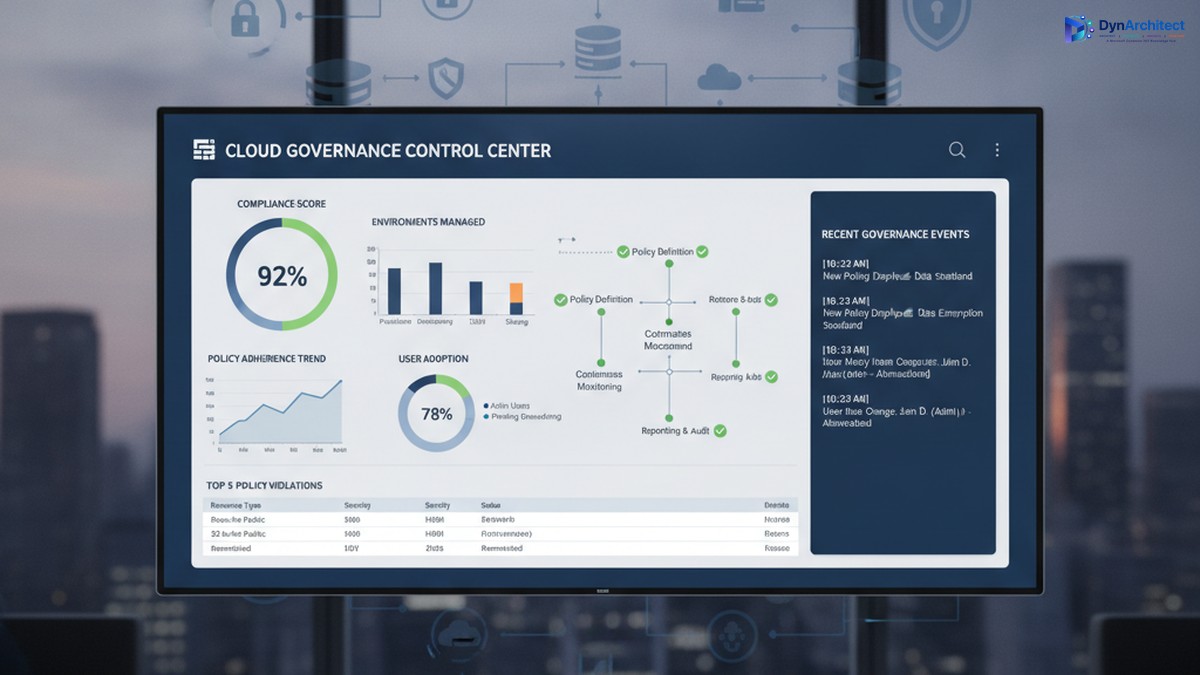
Enterprise cloud governance dashboard showing compliance metrics and governance control center

Building a Center of Excellence for Microsoft Cloud Governance: Establishing Control Without Stalling Innovation

The gap between Microsoft cloud adoption and cloud governance is widening. A CIO with three Power Platform environments deployed across finance, sales, and operations discovers, too late, that each environment has evolved its own authentication rules, data retention policies, and integration patterns. Consolidating them would disrupt active projects. Adding governance now feels like putting handcuffs on people who finally have the tools they need to move fast.

This tension is real, and it is solvable, but it requires a deliberate governance structure: a Center of Excellence (CoE). The purpose of a CoE is not to slow adoption or enforce rigid rules; it is to embed governance into the adoption process itself so that teams can move fast, safely, and with full visibility to leadership.

The Cost of Ungoverned Adoption

When organizations begin adopting Microsoft cloud services, Power Platform, Dynamics 365, Azure, Dataverse, adoption typically starts in one department or use case. A finance team builds a Power App to automate invoice processing. A field service team creates automations to dispatch technicians. Marketing builds a model-driven app to track campaigns. Each team solves a real problem immediately, with minimal delay.

Enterprise cloud governance dashboard showing compliance metrics and governance control center

The problem emerges months later, when three separate environments exist, each configured differently, each with its own data security settings, its own API connectors, and its own integration patterns. A security incident in one triggers questions about the others. A new compliance requirement (data residency, audit logging, export restrictions) means reconfiguring three environments instead of one. A developer leaves, and no one knows what custom logic lives inside automations in that environment. A connector expires, breaking integrations that no one is monitoring centrally.

The cost is not just technical debt. It includes regulatory risk (audit readiness, compliance violations), security risk (data exposure, unauthorized access), operational risk (outages affecting dependent business processes), and financial risk (unused licenses, redundant infrastructure, uncontrolled connector costs). For a mid-market organization, this hidden cost often runs to hundreds of thousands of dollars annually.

Governance after deployment is expensive and disruptive. Retrofitting compliance into three mature environments forces teams to rebuild their solutions or abandon them. Governance before deployment is far cheaper, but it requires structure and clarity on day one.

What a Center of Excellence Is (and Is Not)

A Center of Excellence is a team, function, or governance body responsible for establishing standards, providing guidance, and enforcing policies that keep cloud adoption secure, compliant, and architecturally sound. In the context of Microsoft cloud, a CoE typically has five core responsibilities:

IT leaders and cloud architects collaborating on governance and compliance framework planning

First, it establishes platform standards: which cloud services are approved for use, which are pilot-only, and which are off-limits; which authentication methods are mandatory; how data classification and sensitivity levels map to environments; where connectors can and cannot be used; which compliance frameworks apply (HIPAA, SOC2, PCI DSS, local data residency rules); and how disaster recovery and backup policies are configured.

Second, it onboards new teams and projects by providing reference architectures, reusable templates, and guidance so that new adopters do not have to invent their own governance solutions. A template might be a pre-configured Power Apps environment with the correct security role structure, DLP policies in place, and example connectors already approved and tested.

Third, it monitors ongoing usage and health. This includes license optimization (identifying unused environments and consolidating them), connector audits (catching deprecated or unapproved integrations), security scanning (checking for data exposure and overpermissioned roles), and performance monitoring (identifying resource-intensive automations that need optimization).

Fourth, it provides a feedback loop and governance review process. Teams that encounter a genuine need for a capability that current governance prohibits should be able to propose an exception, and the CoE should evaluate it against risk and organizational goals rather than simply saying no.

Fifth, it acts as an internal consulting function, helping teams plan migrations, optimize environments, troubleshoot problems, and adopt new capabilities safely.

What a CoE is not: it is not a gate that delays innovation. It is not a compliance police force that exists only to say no. It is not a one-person function managed as a side project by someone already stretched thin. These are common failure modes.

Establishing a Governance Foundation

A successful CoE begins with three foundational decisions.

First, secure executive sponsorship and clear governance scope. The CoE needs budget, staffing, and decision-making authority that comes from leadership. Without it, the CoE is a suggestion, not a standard. The scope should define: which Microsoft services the CoE governs (Power Platform, Dynamics 365, Dataverse, Azure, or all of the above); which organizational units must comply (divisions, departments, teams); and what governance decisions the CoE makes directly versus decisions it escalates.

Second, define governance principles that balance control with velocity. A principle might be: “Low-risk, read-only integrations can be self-service and pre-approved; integrations that modify business data require architecture review and security sign-off, but should be approved within two business days, not two weeks.” This principle gives teams clarity on what they can do immediately and what requires review, and it commits the CoE to a review timeline so governance does not become an indefinite bottleneck.

Third, build the governance infrastructure: identify which tools provide visibility and enforcement. This typically includes the Power Platform admin center (for environment management, DLP policies, and connector audits), Azure AD (for identity and access management), Microsoft Purview (for compliance and data governance), and possibly a custom CoE tracker (a Power Apps or Power BI dashboard that centralizes governance data across these tools and makes it visible to team leads and IT leadership).

Staffing and Operating a CoE

A CoE typically starts with a lead (dedicated, not a side project), supported by domain specialists: a Power Platform architect, a Dynamics 365 architect if applicable, a security engineer, and a compliance or risk specialist. For a mid-market organization, this might be three to five people. The CoE lead reports to the CIO or Chief Technology Officer and has direct access to business unit leaders.

The CoE should operate with a clear calendar: environment governance reviews happen monthly, new environment requests are triaged weekly, exception requests are evaluated within two business days, and a quarterly governance review presents data to leadership on usage, compliance status, security incidents, and license optimization opportunities.

Communication is essential. The CoE should publish governance policies in writing (not passed down verbally), maintain a knowledge base with FAQ and troubleshooting guidance, hold a monthly town hall for team leads to learn about new capabilities and governance changes, and send monthly status reports to IT leadership so adoption and governance metrics are visible.

Moving Forward: Quick Wins and Sustained Governance

A CoE need not be perfect from day one. An effective starting point is: document the current state of all cloud environments, establish a data classification standard and assign environments to classification levels, implement DLP policies in Power Platform to prevent data exfiltration, establish environment naming conventions and assign owners, and conduct a security audit to identify and remediate any immediate risks.

Longer-term, invest in automation: automated provisioning of new environments with governance policies pre-applied, automated security scanning and compliance audits, and automated license optimization recommendations. These investments pay off quickly through reduced manual work and faster compliance cycles.

The goal is not perfection. The goal is control: knowing what is deployed, who owns it, what data it contains, and whether it complies with organizational standards. Teams that have this clarity can innovate faster and with less risk, not slower.

Conclusion

A Center of Excellence is how organizations scale cloud adoption from experimental to strategic. It is not governance for governance’s sake; it is governance that removes risk so teams can move confidently. Building one requires executive commitment, clear principles, and sustained staffing, but the return comes quickly in reduced security incidents, faster compliance cycles, and more predictable project outcomes.

At Routeget Technologies, we have built and operated CoE functions for dozens of mid-market and enterprise organizations. We know what works: clear policies, strong automation, and leadership that understands that governance and innovation are not in conflict, they are prerequisites for each other.


#CenterOfExcellence #CloudGovernance #MicrosoftCloud #PowerPlatform #DLP #DataGovernance #ComplianceAutomation #CloudArchitecture #EnterpriseGovernance #DigitalTransformation

Hashtags: #CenterOfExcellence #CloudGovernance #MicrosoftCloud #PowerPlatform #DataGovernance #ComplianceAutomation #CloudArchitecture #EnterpriseGovernance #DigitalTransformation